MCQ
The negative of the work done by the conservative internal forces on a system equals the change in:
  • A
    T​​​​​otal energy.
  • B
    Kinetic energy.
  • Potential energy.
  • D
    None of these.

Answer

Correct option: C.
Potential energy.
Explanation:

The negative of the work done by the conservative internal forces on a system is equal to the changes in potential energy.

i.e. $\text{W}=-\triangle\text{ P.E.}$

Need a full question paper?

Generate a complete, print-ready paper with questions like this in minutes — across 16+ boards, with answer keys.
Start Generating Free

Similar questions

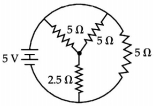
The total current supplied to the circuit as shown in figure by the $5 V$ battery is $A$
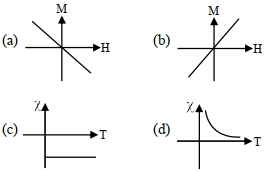
Following plots show Magnetization $(M)$ $vs$ Magnetising field $(H)$ and Magnetic susceptibility $(\chi)$ vs temperature $(T)$ graph :

Which of the following combination will be represented by a diamagnetic material?
A potentiometer has uniform potential gradient. The specific resistance of the material of the potentiometer wire is $10^{-7}$ ohm–meter and the current passing through it is 0.1 ampere; cross-section of the wire is $10^{-6} \mathrm{~m}^2$. The potential gradient along the potentiometer wire is
A nucleus disintegrates into two nuclear parts, in such a way that ratio of their nuclear sizes is $1: 2^{1 / 3}$.Their respective speed have a ratio of $n: 1$. The value of $n$ is $.....$.
It becomes possible to define potential at a point in an electric field because electric field:
A charge $q$ is located at the centre of a cube. The electric flux through any face is
A particle of charge $1\  \mu C\  \&\  mass$ $1\  gm$ moving with a velocity of $4\  m/s$ is subjected to a uniform electric field of magnitude $300\  V/m$ for $10\  sec$. Then it's final speed cannot be.......$m/s$
Two spheres $A$ and $B$ of radius $4\,cm$ and $6\,cm$ are given charges of $80\,\mu c$ and $40\,\mu c$ respectively. If they are connected by a fine wire, the amount of charge flowing from one to the other is
In the CB mode of a transistor, when the collector voltage is changed by 0.5 volt. The collector current changes by 0.05 mA. The output resistance will be
When light is refracted into a medium: