MCQ
the nitration will mainly take place at position -
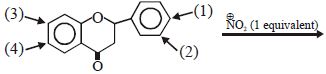
- A$1$
- B$2$
- C$3$
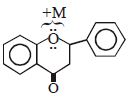
- ✓$4$
Generate a complete, print-ready paper with questions like this in minutes — across 16+ boards, with answer keys.
$n = 4$______________
$n = 3$______________
$n = 2$ _____________
$n = 1$______________
$(a)$ $NCl_3$ is formed when $Cl_2$ is present in excess.
$(b)$ $N_2$ is formed when $Cl_2$ is present in excess.
$(c)$ $N_2$ is formed when $NH_3$ is present in excess.
$(d)$ $NCl_3$ is formed when $NH_3$ is present in excess.
Correct option are
$\begin{array}{*{20}{c}} {{H_3}C - C{H_2} - CH - Et} \\ {\,\,\,\,\,\,\,\,\,\,\,\,\,\,\,\,\,\,\,\,\,\,\,\,\,\,\,\,\,\,\,\,\,\,\,|\,\,\,\,\,\,\,\,\,\,\,\,\,\,\,\,\,\,\,} \\ {\,\,\,\,\,\,\,\,\,\,\,\,\,\,\,\,\,\,\,\,\,\,\,\,\,\,\,\,\,\,\,\,\,\,\,\,C{H_3}\,\,\,\,\,\,\,\,\,\,\,\,\,\,\,} \end{array}$ about $C_2-C_3$ is (figure) 
$[Br^-] = [Cl^-] = [CO_3^{2-} ] = [AsO_4^{3-}] = 0.1\,M$.
Which compound will precipitate with lowest $[Ag^+]$ ?