MCQ
The node point in stationary wave:
  • A
    Change in pressure and maximum displacement
  • B
    Change in pressure and displacement both is zero
  • C
    Change in pressure is zero and displacement maximum
  • Maximum change in pressure and displacment is zero

Answer

Correct option: D.
Maximum change in pressure and displacment is zero
(D)

Need a full question paper?

Generate a complete, print-ready paper with questions like this in minutes — across 16+ boards, with answer keys.
Start Generating Free

Similar questions

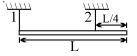
A uniform rod of length $L$ and weight $W$ is suspended horizontally by two vertical ropes as shown. The first rope is attached to the left end of the rod while the second rope is attached a distance $L /4$ from the right end. The tension in the second rope is 
For Boyle’s law to hold, the gas should be:
A container of volume $1{m^3}$is divided into two equal compartments by a partition. One of these compartments contains an ideal gas at $300 K$. The other compartment is vacuum. The whole system is thermally isolated from its surroundings. The partition is removed and the gas expands to occupy the whole volume of the container. Its temperature now would be ..... $K$
The value of $‘g’$ at a particular point is $9.8\,m/{s^2}$. Suppose the earth suddenly shrinks uniformly to half its present size without losing any mass. The value of $‘g’$ at the same point (assuming that the distance of the point from the centre of earth does not shrink) will now be ......... $m/{\sec ^2}$.
A wire of length $L$ and cross-sectional area $A$ is made of a material of Young's modulus $Y.$ It is stretched by an amount $x$. The work done is
Sound wave travels with a velocity of $300\, m\, s^{-1}$ through a gas. $9\, beats$ are produced in $3\, s$ when two waves pass through it simultaneously. If one of the waves has $2\, m$ wavelength, the wavelength of the other wave is ..... $m$
A copper wire of length $4.0m$ and area of cross-section $1.2\,c{m^2}$ is stretched with a force of $4.8 \times {10^3}$ $N.$ If Young’s modulus for copper is $1.2 \times {10^{11}}\,N/{m^2},$ the increase in the length of the wire will be
$STATEMENT$-$1$ A block of mass $\mathrm{m}$ starts moving on a rough horizontal surface with a velocity $\mathrm{v}$. It stops due to friction between the block and the surface after moving through a certain distance. The surface is now tilted to an angle of $30^{\circ}$ with the horizontal and the same block is made to go up on the surface with the same initial velocity $v$. The decrease in the mechanical energy in the second situation is smaller than that in the first situation. because

$STATEMENT$- $2$ The coefficient of friction between the block and the surface decreases with the increase in the angle of inclination.

For a certain organ pipe, the first three resonance frequencies are in the ratio of $1:3:5$ respectively. If the frequency of fifth harmonic is $405\,Hz$ and the speed of sound in air is $324 \,ms ^{-1}$ the length of the organ pipe is $..........m.$
The time period of a satellite of earth is $5\, hours$. If the separation between the centre of earth and the satellite is increased to $4\, times$ the previous value, the new time period will become ....... $h$