Question
The $n^{th}$ term of an AP is $(7 - 4n).$ Find its common difference.

Answer

We have:
$T_n= (7 - 4n)$
Common difference $= T_2 - T_1$
$T_1= 7 - 4 \times 1 = 3$
$T_2 = 7 - 4 \times 2 = -1$
$d = -1 - 3 = -4$
Hence, the common difference is $-4$.

Need a full question paper?

Generate a complete, print-ready paper with questions like this in minutes — across 16+ boards, with answer keys.

Start Generating Free

Similar questions

The perimeter of a triangular field is $540m,$ and its sides are in the ratio $25 : 17 : 12.$ Find the area of the field. Also, find the cost of ploughing the field at $₹ 40$ per $100m^2.$
A bucket of height 24cm is in the form of frustum of a cone whose circular ends are of diameter 28cm and 42cm. Find the cost of milk at the rate of ₹ 30 per litre, which the bucket can hold.
If the mean of the following frequency distribution is 54, find the value of p.
Class
0-20
20-40
40-60
60-80
80-100
Frequency
7
p
10
9
13
If $(\cot\theta+\tan\theta)=\text{m}$ and $(\sec\theta-\cos\theta)=\text{n},$ prove that $\big(\text{m}^2\text{n}\big)^\frac23-\big(\text{m}\text{n}^2\big)^\frac23=1.$
Find the length of each side of a rhombus whose diagonals are 24cm and 10cm long.
If mth term of an is $\frac{1}{\text{n}}$ and nth term is $\frac{1}{\text{m}}$ then find the sum of its first mn terms.
The production yield per hectare of wheat of some farms of a village are given in the following table:
Production yield (in kg/ha)
40-45
45-50
50-55
55-60
60-65
65-70
70-75
75-80
80-85
Number of farms
1
9
15
18
40
26
16
14
10
Draw a less than type ogive and a more than type ogive for this data.
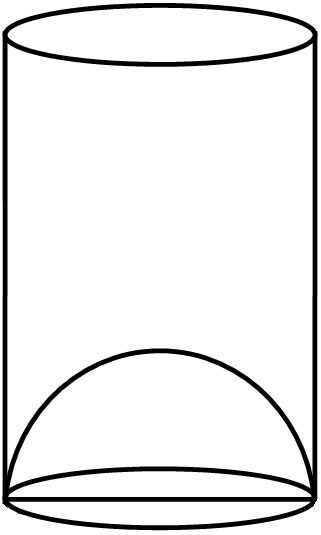
The inner diameter of a glass is $7\ cm$ and it has a raised portion in the bottom in the shape of a hemisphere, as shown in the figure. If the height of the glass is $16\ cm$, find the apparent capacity and the actual capacity of the glass.
The height of an equilateral triangle is 6cm. Find its area. $\big[\text{Take}\sqrt{3}=1.73\big]$
Solve the following systems of equations by using the method of cross multiplication:
$\frac{\text{a}}{\text{x}}-\frac{\text{b}}{\text{y}}=0$
$\frac{\text{ab}^2}{\text{x}}+\frac{\text{a}^2\text{b}}{\text{y}}=\text{a}^2+\text{b}^2,$ where $\text{x}\neq0$ and $\text{y}\neq0$