Question
The nucleus $^{23}_{10}\text{Ne}$ decays by $\beta$ emission. Write down the $\beta$-decay equation and determine the maximum kinetic energy of the electrons emitted. Given that:
$\text{m}(^{23}_{10}\text{Ne})=22.994466\text{ u}.$
$\text{m}(^{23}_{10}\text{Na})=22.089770\text{ u}.$
Answer

The $\beta$-decay of $^{23}_{10}\text{Ne}$ may be represented as:
$^{23}_{10}\text{Ne}\rightarrow\ ^{23}_{11}\text{Na }\ -\ ^{0}_{-1}\text{e }\ +\ \overline{\text{v}}\ +\ \text{Q}$
Ignoring the rest mass of antineutrino $(\overline{\text{v}})$ and electron, we get Mass defect,
$\Delta\text{m}=\text{m}(^{23}_{10}\text{Ne})-\text{m}(^{23}_{11}\text{Na})$
$= 22.994466 - 22.989770$
$= 0.004696\ u$
$\therefore\ \text{Q}=0.004696\times931\text{ MeV}=4.372\text{ MeV}.$
This energy of $4.3792$ MeV, is shared by $e^-$ and $\overline{\text{v}}$ pair because, $^{23}_{11}\text{Na}$ is very massive.
The maximum K.E. of $e^- = 4.372$ MeV, when energy carried by $\overline{\text{v}}$ is zero.

Need a full question paper?

Generate a complete, print-ready paper with questions like this in minutes — across 16+ boards, with answer keys.

Start Generating Free

Similar questions

A charged particle having a charge of $-2.0 \times 10^{-6}C$ is placed close to a nonconducting plate having a surface charge density $4.0 \times 10^{-5}Cm^{-2}$. Find the force of attraction between the particle and the plate.
Write Einstein’s photoelectric equation and point out any two characteristic properties of photons on which this equation is based.
Briefly, explain the three observed features which can be explained by this equation.
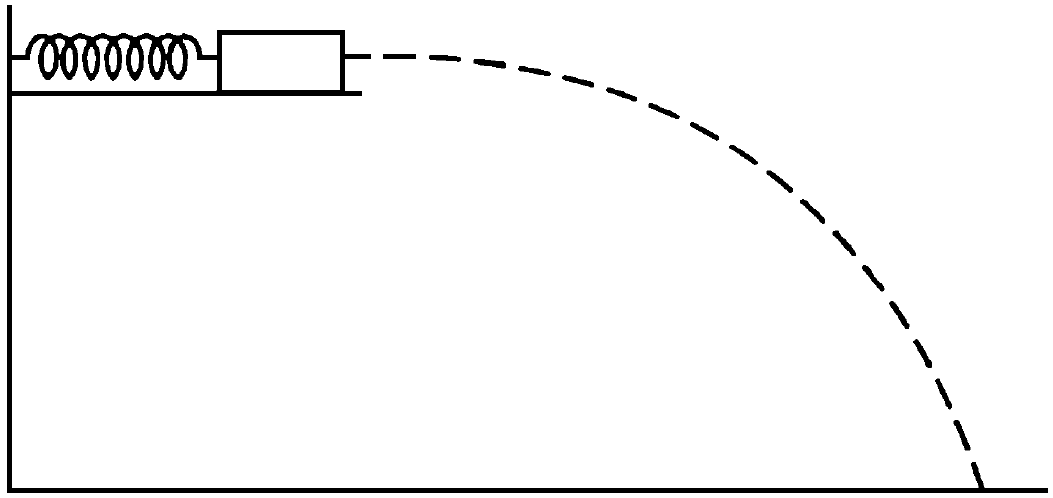
A small block of mass 100g is pressed against a horizontal spring fixed at one end to compress the spring through 5.0cm (figure). The spring constant is 100N/m. When released, the block moves horizontally till it leaves the spring. Where will it hit the ground 2m below the spring?
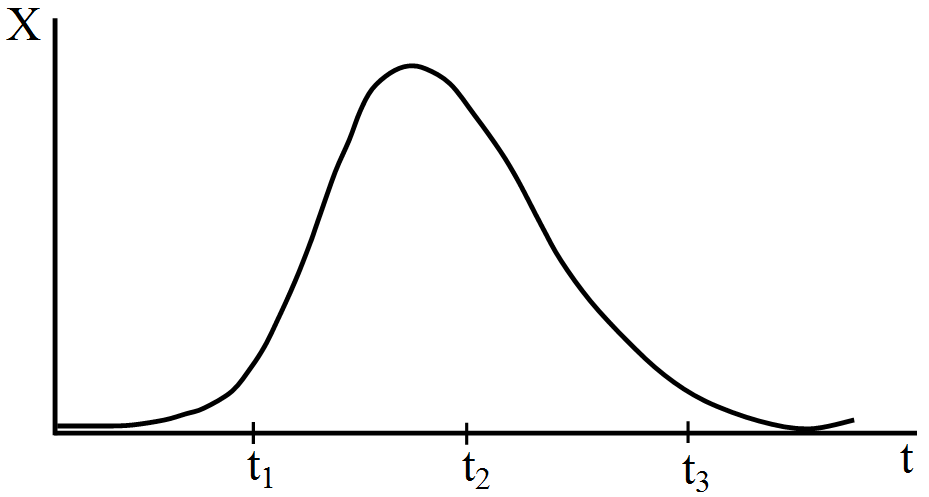
Figure shows the x coordinate of a particle as a function of time. Find the signs of $v_x$ and $a_x$ at $t = t_1, t = t_2$ and $t = t_3.$
  1. In a typical nuclear reaction, e.g.
$^{2}_{1}\text{H} +^{2}_{1}\text{H}\rightarrow^{3}_{2}\text{He} + \text{n} + 3.27\text{MeV}$

although number of nucleons is conserved, yet energy is released. How? Explain.
  1. Show that nuclear density in a given nucleus is independent of mass number A.
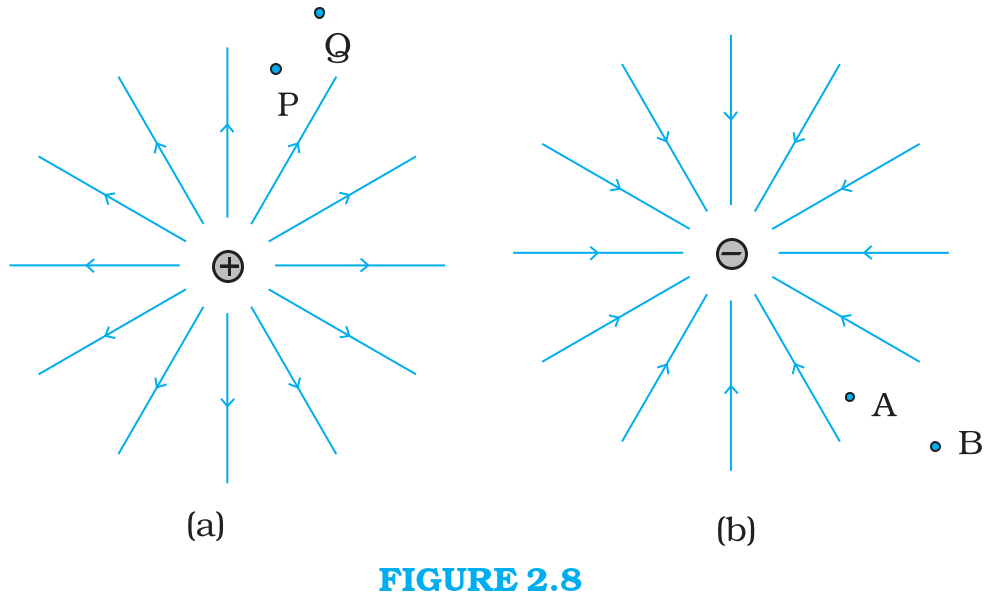
Figures 2.8 (a) and (b) show the field lines of a positive and negative point charge respectively.
Image
(a) Give the signs of the potential difference $V_{ P }-V_{ Q } ; V_{ B }-V_{ A }$.
(b) Give the sign of the potential energy difference of a small negative charge between the points $O$ and $P ; A$ and $B$.
(c) Give the sign of the work done by the field in moving a small positive charge from $Q$ to $P$.
(d) Give the sign of the work done by the external agency in moving a small negative charge from $B$ to $A$.
(e) Does the kinetic energy of a small negative charge increase or decrease in going from $B$ to $A$ ?
The electric current in an X-ray tube (from the target to the filament) operating at 40kV is 10mA. Assume that on an average, 1% of the total kinetic energy of the electron hitting hte target are converted into X-rays.
  1. What is the total power emitted as X-rays
  2. How much heat is produced in the target every second?
A ball is dropped from a balloon going up at a speed of 7m/s. If the balloon was at a height 60m at the time of dropping the ball, how long will the ball take in reaching the ground?
Two small balls A and B, each of mass m, are joined rigidly by a light horizontal rod of length L. The rod is clamped at the centre in such a way that it can rotate freely about a vertical axis through its centre. The system is rotated with an angular speed w about the axis. A particle P of mass m kept at rest sticks to the ball A as the ball collides with it. Find the new angular speed of the rod.
A small flat search coil of area $5 cm^2$ with $140$ closely wound turns is placed between the poles of a powerful magnet producing magnetic field $0.09 \ T$ and then quickly removed out of the field region. Calculate
$a.$ change of magnetic flux through the coil, and
$b.$ emf induced in the coil.