Question
The nucleus  after two successive
  decays will give
|
(a) |
(b) |
(c) |
(d) |
The nucleus after two successive decays will give
|
(a) |
(b) |
(c) |
(d) |
(d) 
Generate a complete, print-ready paper with questions like this in minutes — across 16+ boards, with answer keys.
Two identical short bar magnets, each having magnetic moment of 10 Am2, are arranged such that their axial lines are perpendicular to each other and their centres be along the same straight line in a horizontal plane. If the distance between their centres is 0.2 m, the resultant magnetic induction at a point midway between them is (
|
(a) |
(b) |
(c)  Tesla Tesla
|
(d)  Tesla Tesla
|
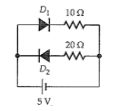
Which of the following statement is true
|
(a) The presence of a large magnetic flux through a coil maintains a current in the coil if the circuit is continuous |
|
(b) A coil of a metal wire kept stationary in a non-uniform magnetic field has an e.m.f. induced in it |
|
(c) A charged particle enters a region of uniform magnetic field at an angle of 85° to the magnetic lines of force;the path of the particle is a circle |
|
(d) There is no change in the energy of a charged particle moving in a magnetic field although a magnetic force is acting on it |
A capacitor of capacity C has charge Q and stored energy is W. If the charge is increased to 2Q, the stored energy will be
|
(a) 2W |
(b) W/2 |
(c) 4W |
(d) W/4 |
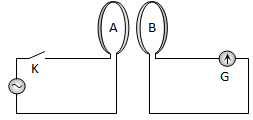
The diagram below shows two coils A and B placed parallel to each other at a very small distance. Coil A is connected to an ac supply. G is a very sensitive galvanometer. When the key is closed
|
(a) Constant deflection will be observed in the galvanometer for 50 Hz supply |
|
(b) Visible small variations will be observed in the galvanometer for 50 Hz input |
|
(c) Oscillations in the galvanometer may be observed when the input ac voltage has a frequency of 1 to 2 Hz |
|
(d) No variation will be observed in the galvanometer even when the input ac voltage is 1 or 2 Hz |
$\lambda_\text{e}=\lambda_\text{p}.$
$\lambda_\text{e}<\lambda_\text{p}.$
$\lambda _\text{e}>\lambda_\text{p}.$
The relation between


