MCQ
The number of elements present in fifth period is
  • $18$
  • B
    $32$
  • C
    $8$
  • D
    $24$

Answer

Correct option: A.
$18$
a
The fifth period starts with $Rb \,(37)$ to $Xe\, (54)$. Therefore, a total of $18$ elements.

Need a full question paper?

Generate a complete, print-ready paper with questions like this in minutes — across 16+ boards, with answer keys.

Start Generating Free

Similar questions

Which one of the following metals can not be obtained on electrolysis of aqueous solution of its salts ?
The major product formed in the following reaction is

$\begin{array}{*{20}{c}}
  {\begin{array}{*{20}{c}}
  {\,\,\,\,\,\,\,C{H_3}} \\ 
  | 
\end{array}} \\ 
  {C{H_3} - C - C{H_3}} \\ 
  | \\ 
  H 
\end{array}{\mkern 1mu} $ $\mathop {\xrightarrow{{C{H_3}OBr}}}\limits_{C{H_3}OH} $
Which has yellow colour
Among given species identify the isostructural pairs
Are which type of isomers
Anode rays were discovered by
Methyl alcohol is toxic. The reason assigned is
The $IUPAC$ name of $\begin{matrix}
   \,\,\,\,\,\,\,\,\,\,\,\,\,\,\,\,\,\,\,\,\,\,\,\,\,\,\,\,\,\,\,\,\,\,\,\,\,\,\,\,\,\,\,\,\,\,\,\,\,\,\,\,\,\,\,C{{H}_{3}}  \\
   \,\,\,\,\,\,\,\,\,\,\,\,\,\,\,\,\,\,\,\,\,\,\,\,\,\,\,\,\,\,\,\,\,\,\,\,\,\,\,\,\,\,\,\,\,\,\,\,|  \\
   C{{H}_{3}}-CH-CH-CH-C-C{{H}_{3}}  \\
   |\,\,\,\,\,\,\,\,\,\,\,\,\,\,\,|\,\,\,\,\,\,\,\,\,\,\,\,\,\,\,\,\,|\,\,\,\,\,\,\,\,\,\,\,\,\,\,\,|  \\
   \,\,\,\,\,OH\,\,\,\,\,\,\,\,C{{H}_{3}}\,\,\,\,\,\,\,\,OH\,\,\,\,\,\,\,\,C{{H}_{3\,\,}}  \\
\end{matrix}$ is
Calculate the amount of water evaporated if $2.8\ kg$ of $2\ m\ CaBr_2$ solution is heated to $110\,^o\ C$ at $1\ atm$ .......... $gm$

(Given : $K_b$ of water $=0.5\ Kkg/mol$ . ; Atomic mass of $Ca =40$ , $Br =80$)

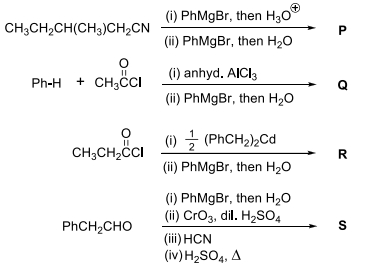
In the following reactions, $P, Q, R$, and $S$ are the major products.

The correct statement($s$) about $P, Q, R$, and $S$ is(are)

($A$) Both $P$ and $Q$ have asymmetric carbon($s$).

($B$) Both $Q$ and $R$ have asymmetric carbon($s$).

($C$) Both $P$ and $R$ have asymmetric carbon($s$).

($D$) $P$ has asymmetric carbon(s), $S$ does not have any asymmetric carbon.