MCQ
The number of points in $(-\infty, \infty)$, for which $x^2-x \sin x-\cos x=0$, is
  • A
    $6$
  • B
    $4$
  • $2$
  • D
    $0$

Answer

Correct option: C.
$2$
c
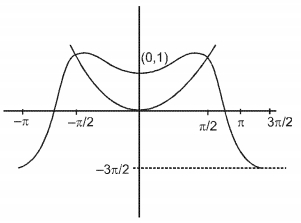
$x^2=x \sin x+\cos x $

$f(x)=x^2 $

$g(x)=x \sin x+\cos x $

$g^{\prime}(x)=\sin x+x \cos x-\sin x $

$g^{\prime}(x)=x \cos x$
Need a full question paper?

Generate a complete, print-ready paper with questions like this in minutes — across 16+ boards, with answer keys.

Start Generating Free

Similar questions

If ${\left( {\frac{{1 + \cos \theta + i\sin \theta }}{{i + \sin \theta + i\cos \theta }}} \right)^4} = \cos n\theta + i\sin n\theta $, then $n$ is equal to
For any integer $k$ , let $w_k$ = $\cos \left( {\frac{{k\pi }}{{11}}} \right) + i\,\sin \left( { \frac{{k\pi }}{{11}}} \right)$ where $i$ = $\sqrt {-1}$ . The value of the expression $\frac{{\sum\limits_{k = 1}^8 {\left| {{w_{2k + 1}} - {w_{2k}}} \right|} }}{{\sum\limits_{k = 1}^4 {\left| {{w_{3k - 1}} - {w_{3k - 2}}} \right|} }}$ is
If $f(x) = \left\{ \begin{array}{l}a{x^2} - b,{\rm{ }}0 \le x < 1\\2,\;{\rm{ }}x = 1\\x + 1,{\rm{ 1}} < x \le 2\end{array} \right.$ is continuous at $x = 1$, then the most suitable value of $a, b$ are
Let $\vec{a}, \vec{b}, \vec{c}$ be three non-coplanar vectors such that $\overrightarrow{ a } \times \overrightarrow{ b }=4 \overrightarrow{ c }, \overrightarrow{ b } \times \overrightarrow{ c }=9 \overrightarrow{ a }$ and $\overrightarrow{ c } \times \overrightarrow{ a }=\alpha \overrightarrow{ b }, \alpha>0$ . If $|\vec{a}|+|\vec{b}|+|\vec{c}|=36$, then $\alpha$ is equal to$....$ 
$\int_{}^{} {\frac{{\sin x\cos x}}{{a{{\cos }^2}x + b{{\sin }^2}x}}dx = } $
The value of the integral $\int_{ - 1}^1 {\frac{d}{{dx}}\left( {{{\tan }^{ - 1}}\frac{1}{x}} \right)} \,dx$ is
If $X = \left[ {\begin{array}{*{20}{c}}3&{ - 4}\\1&{ - 1}\end{array}} \right]$, then the value of ${X^n}$ is
Let $f:[1, \infty) \rightarrow[2, \infty)$ be a differentiable function such that $f(1)=2$. If $6 \int_1^x f(t) d t=3 x f(x)-x^3$ for all $x \geq 1$, then the value of $f(2)$ is
Let $a_1, a_2, a_3, \ldots$ be in an arithmetic progression of positive terms.

Let $\mathrm{A}_{\mathrm{k}}=\mathrm{a}_1{ }^2-\mathrm{a}_2{ }^2+\mathrm{a}_3{ }^2-\mathrm{a}_4{ }^2+\ldots+\mathrm{a}_{2 \mathrm{k}-1}{ }^2-\mathrm{a}_{2 \mathrm{k}}{ }^2$.

If $\mathrm{A}_3=-153, \mathrm{~A}_5=-435$ and $\mathrm{a}_1{ }^2+\mathrm{a}_2{ }^2+\mathrm{a}_3{ }^2=66$, then $\mathrm{a}_{17}-\mathrm{A}_7$ is equal to....................

Statement $-1$ : The slope of the tangent at any point $P$ on a parabola, whose axis is the axis  of $x$ and vertex is at the origin, is inversely proportional to the ordinate of the point $P$.
Statement $-2$ : The system of parabolas $y^2 = 4ax$ satisfies a differential equation of degree $1$ and order $1$