MCQ
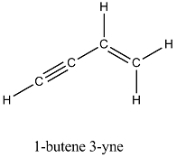
The number of sigma and pi-bonds in $1-$ butene $3-$ yne are
  • A
    $5$ sigma and $5$ pi
  • $7$ sigma and $3$ pi
  • C
    $8$ sigma and $2$ pi
  • D
    $6$ sigma and $4$ pi

Answer

Correct option: B.
$7$ sigma and $3$ pi
b
The number of sigma and $pi$-bonds in $1$-butene $3$- yne are $7$ sigma and $3$ pi. It has one $C = C$ double bond which contains one pi bond. It has one $C \equiv C$ triple bond which contains two pi bonds. It has $3$ carbon carbon sigma bonds and $4 C - H$ pi bonds.

Need a full question paper?

Generate a complete, print-ready paper with questions like this in minutes — across 16+ boards, with answer keys.

Start Generating Free

Similar questions

Identify $Z$ in the series 

$C{H_2} = C{H_2}\xrightarrow{{HBr}}X\xrightarrow[{{I_2}(excess)}]{\begin{subarray}{l} 
  Hydrolisis \\ 
  N{a_2}C{O_3} 
\end{subarray} }Z$

The mutual heat of neutralisation of $40 \,gm$  of $NaOH$ and $60\, gm $ $C{H_3}COOH$ will be
All element in $3$$^{rd}$ period have
Which of the following is the correct order of gradually decreasing basic nature of the oxides
The electronic configuration of three elements $A,B$ and $C$ are given below. Stable form of $C$ may be represented by the formula

$A : 1s^2\, 2s^2\, 2p^6$

$B : 1s^2\, 2s^2\, 2p^6\, 3s^2\, 3p^3$

$C : 1s^2\, 2s^2\, 2p^6\, 3s^2\, 3p^5$

The correct structure of 

$6-$ amino $-4-$ hydroxycyclohex $-2-$ ene $-1-$ sulphonic acid is

Reaction, ${H_2}(g) + {I_2}(g) \to 2HI(g)$ $\Delta H = - 12.40\,kcal$. According to this, the heat of formation of $ HI $ will be......$kcal$
For the reaction at $298 \mathrm{~K}, 2 \mathrm{~A}+\mathrm{B} \rightarrow \mathrm{C} . \Delta \mathrm{H}$ $=400 \mathrm{~kJ} \mathrm{~mol}^{-1}$ and $\Delta \mathrm{S}=0.2 \mathrm{~kJ} \mathrm{~mol}^{-1} \mathrm{~K}^{-1}$. The reaction will become spontaneous above. . . . . . .$\mathrm{K}$
If $0.1\, M, 100\, mL \,NaOH$ solution is mixed with $0.05\, M, 100\, mL \,H_2SO_4$ solution the $pH$ of resulting solution is :
Assertion : For an isothermal reversible process $Q = -W$ i.e. work done by the system equals the heat absorbed by the system.
Reason : Enthalpy change $(\Delta H)$ is zero for isothermal process.