MCQ
The only $o, p-$ directing group which is deactivating in nature is
- A$ - N{H_2}$
- B$ - OH$
- ✓$ - X$ (halogens)
- D$ - R$ (alkyl groups)
o. p. directing groups are as follow :
$ - C{H_3},{C_2}{H_5}( - R), - N{H_2}, - OH$, halogens $(Cl,\,Br,\,I)$.
Generate a complete, print-ready paper with questions like this in minutes — across 16+ boards, with answer keys.
$A.$ Surface tension is the outcome of equal attractive and repulsion forces acting on the liquid molecule in bulk.
$B.$ Surface tension is due to uneven forces acting on the molecules present on the surface.
$C.$ The molecule in the bulk can never come to the liquid surface.
$D.$ The molecules on the surface are responsible for vapour pressure if the system is a closed system.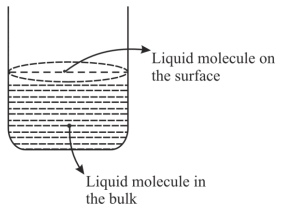
$M{g^{2 + }} + 2{e^ - } \to Mg(s);\,\,E = - 2.37\,V$
$C{u^{2 + }} + 2{e^ - } \to Cu(s);\,\,\,E = + 0.33\,V$
(given $R = \frac{{8.3\,J}}\,{{mol - K}}$, $1$ $lit$ -$atm$ $=$ $100$ $J$ $ln$ $2$ $=$ $0.693$)