MCQ
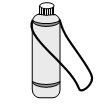
The only possibility of heat flow in a thermos flask is through its cork which is $75 cm^2$ in area and $5 cm$ thick. Its thermal conductivity is $0.0075 cal/cmsec^oC$. The outside temperature is$ 40^oC$ and latent heat of ice is $80 cal g^{-1}$. Time taken by $500 g$ of ice at $0^oC$ in the flask to melt into water at $0^oC$ is ....... $hr$
  • $2.47$
  • B
    $4.27 $
  • C
    $7.42 $
  • D
    $4.72$

Answer

Correct option: A.
$2.47$
a
(a) $mL = \frac{{KA\Delta \theta \,\,t}}{{\Delta x}}$

==> $500 \times 80 = \frac{{0.0075 \times 75 \times (40 - 0)t}}{5}$

==>$ t = 8.9 \times 10^3 sec = 2.47 hr.$

Need a full question paper?

Generate a complete, print-ready paper with questions like this in minutes — across 16+ boards, with answer keys.

Start Generating Free

Similar questions

A ball of mass $3\ kg$ collides with a wall with velocity $10m/ \sec$ at an angle of $30^\circ$ with the wall and after collision reflects at the same angle with the same speed. The change in momentum of ball in $\text{MKS}$ unit is:
If the collision frequency of hydrogen molecules in a closed chamber at $27^{\circ} \mathrm{C}$ is $\mathrm{Z}$, then the collision frequency of the same system at $127^{\circ} \mathrm{C}$ is :
Two bars of thermal conductivities $K$ and $3K$ and lengths $1\,\, cm$ and $2\,\, cm$ respectively have equal cross-sectional area, they are joined lengths wise as shown in the figure. If the temperature at the ends of this composite bar is $0\,^oC$ and $100\,^oC$ respectively (see figure), then the temperature $\varphi $ of the interface is......... $^oC$
A particle of mass $0.01 \;kg$ travels with velocity given by $4 \hat{ i }+16 \hat{ k } \;ms ^{-1}$. After sometime, its velocity becomes $8 \hat{ i }+20 \hat{ j }\;ms ^{-1}$. The work done on particle during this interval of time is ...... $J$
A mass is performing vertical circular motion $($see figure$)$. If the average velocity of the particle is increased, then at which point is the maximum breaking possibility of the string:
When three forces of $50 \,N, 30\, N $ and $15\,N$ act on a body, then the body is
One Mach number is equal to
In a head on elastic collision of a very heavy body moving with velocity $v$ with a light body at rest. Then, the velocity of heavy body after collision is:
A particle of mass $m$ moving with velocity $u$ makes an elastic one dimensional collision with a stationary particle of mass $m$. They are in contact for a very short time $T$. Their force of interaction increases from zero to $F_0$ linearly in time $T/2$, and decreases linearly to zero in further time $T/2$. The magnitude of $F_0$ is
A piece of wood is taken deep inside a long column of water and released. It will move up: