MCQ
The orbital speed of Jupiter is
  • A
    Greater than the orbital speed of earth
  • Less than the orbital speed of earth
  • C
    Equal to the orbital speed of earth
  • D
    Zero

Answer

Correct option: B.
Less than the orbital speed of earth
b
(b) Orbital radius of Jupiter > Orbital radius of Earth

$\frac{{{v_J}}}{{{v_e}}} = \frac{{{r_e}}}{{{r_J}}}$            As ${r_J} > {r_e}$    therefore ${v_J} < {v_e}$

Need a full question paper?

Generate a complete, print-ready paper with questions like this in minutes — across 16+ boards, with answer keys.
Start Generating Free

Similar questions

Consider the sound wave travelling in ideal gases of $\mathrm{He}, \mathrm{CH}_{4}$, and $\mathrm{CO}_{2}$. All the gases have the same ratio $\frac{P}{\rho}$, where $P$ is the pressure and $\rho$ is the density. The ratio of the speed of sound through the gases $\text v_{\mathrm{He}}: \mathrm{v}_{\mathrm{CH}_{4}}: \mathrm{v}_{\mathrm{CO}_{2}}$ is given by
A body of mass $1.0\,kg$ is falling with an acceleration of $10 \,m/se{c^2}$. Its apparent weight will be ......... $kg\,wt$ $(g = 10\,m/{\sec ^2})$ 
A man of $50\, kg$ mass is standing in a gravity free space at a height of $10\, m$ above the floor. He throws a stone of $0.5\, kg$ mass downwards with a speed $2\, m/s$. When the stone reaches the floor, the distance of the man above the floor will be ...... $m$
A proton moving with a constant velocity, passes through a region of space without change in its velocity. If $E$ $\& B$ represent the electric and magnetic fields respectively, this region may have
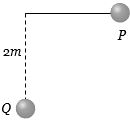
A pendulum of length $2\,m$ lift at $P$. When it reaches $Q$, it losses $10\%$ of its total energy due to air resistance. The velocity at $Q$ is .... $m/sec$
Photoelectric emission occurs only when the incident light has more than a certain minimum
A bullet of mass $0.02\, kg$ travelling horizontally with velocity $250\, ms^{-1}$ strikes a block of wood of mass $0.23\, kg$ which rests on a rough horizontal surface. After the impact, the block and bullet move together and come to rest after travelling a distance of $40\,m$. The coefficient of sliding friction of the rough surface is $(g = 9.8\, ms^{-2})$
Fission of nuclei is possible because the binding energy per nucleon in them
At a certain place the angle of dip is $30^{\circ}$ and the horizontal component of earth's magnetic field is $0.5 G$. The earth's total magnetic field (in $G$ ), at that certain place, is ................
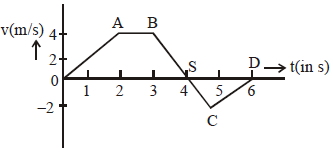
The velocity $(v)$ and time $(t)$ graph of a body in a straight line motion is shown in the figure. The point $S$ is at $4.333$ seconds. The total distance covered by the body in $6 \;s$ is$.......m$