Question
The orbital speed of Jupiter is

Answer

(b) Orbital radius of Jupiter > Orbital radius of Earth

$\frac{{{v_J}}}{{{v_e}}} = \frac{{{r_e}}}{{{r_J}}}$            As ${r_J} > {r_e}$    therefore ${v_J} < {v_e}$

Need a full question paper?

Generate a complete, print-ready paper with questions like this in minutes — across 16+ boards, with answer keys.
Start Generating Free

Similar questions

Two forces of magnitude $F$ have a resultant of the same magnitude $F$. The angle between the two forces is ........ $^o$
A copper disc of radius $0.1\, m$ rotates about its centre with $10$ revolutions per second in a uniform magnetic field of $0.1$ Tesla. The emf induced across the radius of the disc is
The potential energy of a simple harmonic oscillator when the particle is half way to its end point is:
A person observes two moving trains, '$A$' reaching the station and '$B$' leaving the station with equal speed of $30\,m / s$. If both trains emit sounds with frequency $300\,Hz$, (Speed of sound : $330\,m / s$ ) approximate difference of frequencies heard by the person will be $..........Hz$
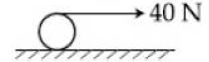
A string is wound around a hollow cylinder of mass $5\, kg$ and radius $0.5\,m$. If the string is now pulled with a horizontal force of $40\, N$, and the cylinder is rolling without slipping on a horizontal surface (see figure), then the angular acceleration of the cylinder will be ......... $rad/s^2$ .(Neglect the mass and thickness of the string)
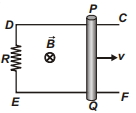
A frame $C D E F$ is placed in a region where a magnetic field $\vec{B}$ is present. A rod of length one metre moves with constant velocity $20 \,m / s$ and strength of magnetic field is one tesla. The power spent in the process is .............. $kW$ (take $R=$ $0.2 \,\Omega$ and all other wires and rod have zero resistance)
In a potentiometer wire experiment the $\mathrm{emf}$ of a battery in the primary circuit is $20\,V$ and its internal resistance is $5\,\Omega$ . There is a resistance box in series with the battery and the potentiometer wire, whose resistance can be varied from $120\,\Omega$ to $170\,\Omega$ . Resistance of the potentiometer wire is $75\,\Omega$ . The following potential differences can be measured using this potentiometer.
Which statement is correct for product $‘X’$ ?

$\begin{array}{*{20}{c}}
  {O\,\,\,\,\,\,\,\,\,\,\,\,\,\,\,\,\,\,\,\,\,\,\,\,\,\,C \equiv CH\,\,\,\,\,\,\,\,\,\,\,\,\,\,\,\,\,\,\,\,\,\,\,\,\,\,\,\,\,O\,\,\,} \\ 
  {\,\,\,\,\,\,\,\,\,\,\,\,\,\,\,||\,\,\,\,\,\,\,\,\,\,\,\,\,\,\,\,\,\,\,\,\,\,\,\,\,\,\,\,|\,\,\,\,\,\,\,\,\,\,\,\,\,\,\,\,\,\,\,\,\,\,\,\,\,\,\,\,\,\,\,\,\,\,\,\,\,\,\,\,\,\,\,\,\,\,\,||\,\,\,\,\,\,\,\,\,\,\,\,\,\,\,\,\,\,\,} \\ 
  {Cl - C - C{H_2} - C - C{H_2} - C{H_2} - C - C{H_3}} \\ 
  {|\,\,\,\,\,\,\,\,\,\,\,\,\,\,\,\,\,\,\,\,\,\,\,\,} \\ 
  {C{H_2}\,\,\,\,\,\,\,\,\,\,\,\,\,\,\,\,\,\,} \\ 
  {|\,\,\,\,\,\,\,\,\,\,\,\,\,\,\,\,\,\,\,\,\,\,\,\,\,} \\ 
  {C \equiv N\,\,\,\,\,\,\,\,\,\,\,\,\,\,\,} 
\end{array}$ $\xrightarrow[{BaS{O_4}}]{{{H_2}/Pd}}\,'X'$

Two particles $X $ and $Y$, of equal mass and with unequal positive charges, are free to move and are initially far away from each other. With $Y$ at rest, $X$ begins to move towards it with initial velocity $u$. After a long time, finally
For the structural analysis of crystals, $X-$ rays are used because