MCQ
The order of $[x\,y\,z]\,\,\left[ {\begin{array}{*{20}{c}}a&h&g\\h&b&f\\g&f&c\end{array}} \right]\,\left[ \begin{array}{l}x\\y\\z\end{array} \right]$ is
  • A
    $3 \times 1$
  • $1 \times 1$
  • C
    $1 \times 3$
  • D
    $3 \times 3$

Answer

Correct option: B.
$1 \times 1$
b
(b) Order will be $(1 \times 3)(3 \times 3)(3 \times 1) = (1 \times 1)$.

Need a full question paper?

Generate a complete, print-ready paper with questions like this in minutes — across 16+ boards, with answer keys.
Start Generating Free

Similar questions

The points A(1, 1, 0), B(0, 1, 1), C(1, 0, 1) and $\text{D}\big(\frac{2}{3},\frac{2}{3},\frac{2}{3}\big)$
  1. Coplanar
  2. Non-coplanar
  3. Vertices of a parallelogram
  4. None of these
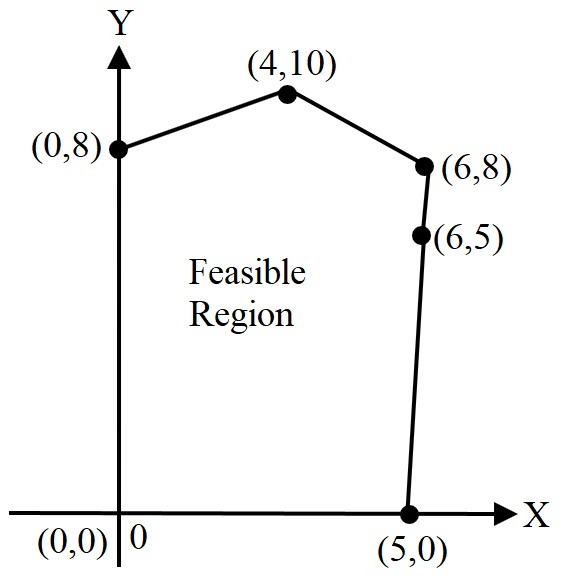
The feasible, region for an LPP is shown shaded in the figure. Let Z = 3x - 4y be the objective function. A minimum of Z occurs at:

  1. (0, 0)
  2. (0, 8)
  3. (5, 0)
  4. (4, 10)
Let $f: R \rightarrow R$ be defined as

$f(\mathrm{x})= -\frac{4}{3} x^{3}+2 x^{2}+3 x ,\quad x>0$

$\quad\quad\quad\quad 3 x e^{x}, \quad\quad\quad\quad\quad\quad\mathrm{x} \leq 0$

Then $\mathrm{f}$ is increasing function in the interval.

If $f(x)=\int_0^x e^{t^2}(t-2)(t-3) d t$ for all $x \in(0, \infty)$, then

$(A)$ $f$ has a local maximum at $x=2$

$(B)$ $f$ is decreasing on $(2,3)$

$(C)$ there exists some $c \in(0, \infty)$ such that $f ^{\prime \prime}( c )=0$

$(D)$ $f$ has a local minimum at $x=3$

Points within and on the boundary of the feasible region represents feasible solutions of the constraints. Any point outside the feasible region is an
If an error of k% is made in measuring the radius of a sphere, then percentage error in its volume is:
  1. k%
  2. 3k%
  3. 2k%
  4. $\frac{\text{k}}{3}\%$
Let $f: R \rightarrow R$ be a differentiable function such that $f(a)=0=f(b)$ and $f^{\prime}(a) f^{\prime}(b) > 0$ for some $a < b$. Then, the minimum number of roots of $f^{\prime}(x)=0$ in the interval $(a, b)$ is
If $\left| {\begin{array}{*{20}{c}}
{a - b - c}&{2a}&{2a}\\
{2b}&{b - c - a}&{2b}\\
{2c}&{2c}&{c - a - b}
\end{array}} \right|$ $ = \left( {a + b + c} \right)\,{\left( {x + a + b + c} \right)^2}$ , $x   \ne 0$ and $a + b + c \ne 0$, then $x$ is equal to
If $A = \left[ {\begin{array}{*{20}{c}}1&0&1\\0&1&1\\1&0&0\end{array}} \right]$, then $A$ is
If $\text{A} =\displaystyle \begin{bmatrix} -1 &\text{amp; } 0 &\text{amp; }0 \\ 0 &\text{amp; }\text{x} &\text{amp; } 0 \\ 0 &\text{amp; } 0 &\text{amp; }\text{m} \end{bmatrix}$is a scalar matrix then $\text{x}+\text{m}=$
  1. 0
  2. -1
  3. -2
  4. -3