MCQ
The output of OR gate is 1
  • A
     If both inputs are zero
  •  If either or both inputs are 1
  • C
     Only if both input are 1
  • D
     If either input is zero

Answer

Correct option: B.
 If either or both inputs are 1
 If either or both inputs are 1

Need a full question paper?

Generate a complete, print-ready paper with questions like this in minutes — across 16+ boards, with answer keys.
Start Generating Free

Similar questions

At the first minimum adjacent to the central maximum of a single-slit diffraction pattern, the phase difference between the Huygen's wavelet from the edge of the slit and the wavelet from the midpoint of the slit is 
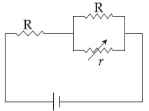
In the circuit shown, the resistance $r$ is a variable resistance. If for $r = fR,$  the heat generation in $r$ is maximum then the value of $f$ is 
A horizontal overhead power line is at a height of $4\,m$ from the ground and carries a current of $100\,A$ from east to west. The magnetic field directly below it on the ground is $(\mu _0 = 4\pi \times 10^{-7}\,TmA^{-1})$
Equipotential surfaces associated with an electric field which is increasing in magnitude along the x-direction are
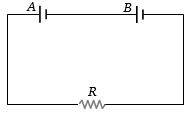
Two batteries $A$ and $B$ each of $e.m.f.$ $2\, V$ are connected in series to an external resistance $R = 1 \,ohm$. If the internal resistance of battery $A$ is $1.9\, ohms$ and that of $B$ is $0.9\, ohm$, what is the potential difference between the terminals of battery $A$ ............. $V$
The magnetic moment of a bar magnet is thus $...A...$ to the magnetic moment of an equivalent solenoid that produces the same magnetic field. Here, $A$ refers to.
In frequency modulation
Nuclear reaction are given as

$(i)\, \square$$ (n, p) _{15} p^{32}$

$(ii)\, \square (p, \alpha){_8}O^{16}$

$(iii)\, _7 N^{14} (\square \,\, p)  _6 C^{14}$

missing particle or nuclide (in box $\square$) in these reactions are respectively

Unpolarized light falls on two polarizing sheets placed one on top of the other. What must be the angle between the characteristic directions of the sheets if the intensity of the final transmitted light is one-third the maximum intensity of the first transmitted beam
A $1\,m$ long copper wire carries a current of $1\,A$. If the cross section of the wire is $2.0\,mm ^{2}$ and the resistivity of copper is $1.7 \times 10^{-8}\,\Omega\,m$. the force experienced by moving electron in the wire is $\times 10^{-23}\,N$. (charge on electron $=1.6 \times 10^{-19}\,C$ )