MCQ
The output of OR gate of two input terminals will be zero only when :
  • Any one of inputs is 1
  • B
    Both inputs are 1
  • C
    Any one of inputs is zero
  • D
    Both inputs are zero

Answer

Correct option: A.
Any one of inputs is 1
A

Need a full question paper?

Generate a complete, print-ready paper with questions like this in minutes — across 16+ boards, with answer keys.
Start Generating Free

Similar questions

A circular coil $'A\ ’$ has a radius $R$ and the current flowing through it is $I.$ Another circular coil $'B\ ’$ has a radius $2R$ and if $2I$ is the current flowing through it, then the magnetic fields at the centre of the circular coil are in the ratio of (i.e. $B _{ A }$ to $B _{ B }$ )
At a certain distance from a point charge the electric field is 500 V/m  and the potential is 3000 V. What is this distance(a) 6 m(b) 12 m(c) 36 m  (d) 144 m
       
For intensity I of a light of wavelength 5000Å the photoelectron saturation current is 0.40 μA and stopping potential is 1.36 V, the work function of metal is(a) 2.47 eV(b) 1.36 eV(c) 1.10 eV(d) 0.43 eV
       
If a charged particle projected in a gravity-free room deflects:
Two lenses having $f_1 : f_2 = 2 : 3$ has combination to make no dispersion. Find the ratio of dispersive power of glasses used
The significant result deduced from the Rutherford's scattering experiment is that:
In a circuit $L, C$ and $R$ are connected in series with an alternating voltage source of frequency $f$. The current leads the voltage by $45^\circ$ . The value of $C$ is.
When light travels from one medium to the other of which the refractive index is different, then which of the following will change(a) Frequency, wavelength and velocity(b) Frequency and wavelength(c) Frequency and velocity(d) Wavelength and velocity
   
   
Which one of the following is the weakest kind of bonding in solids(a) Ionic  (b) Metallic(c) Vander Waals(d) Covalent
       
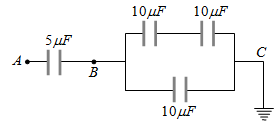
In the given circuit if point $C$ is connected to the earth and a potential of $+2000 V$  is given to the point $A,$ the potential at $B$ is