MCQ
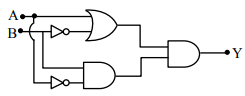
The output Y of following circuit for given inputs is :
Image
  • A
    $A \cdot B ( A + B )$
  • B
    A • B
  • C
    $0$
  • D
    $\overline{ A } \cdot B$

Answer

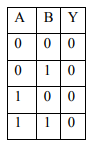
By truth table.
Image

Need a full question paper?

Generate a complete, print-ready paper with questions like this in minutes — across 16+ boards, with answer keys.

Start Generating Free

Similar questions

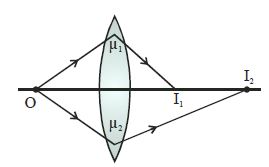
A lens made up of different material forms two images of a point object $'O'$ as shown in figure. Then
A tangent galvanometer has a coil of $25$ $turns$ and a radius of $15\, cm$. The horizontal component of the earth’s magnetic field is $3\times10^{-5}\, T$. The current required to produce a deflection of $45^o$ in it is....$A$
If $r.m.s.$ velocity of a gas is ${V_{rms}} = 1840m/s$ and its density $\rho = 8.99 \times {10^{ - 2}}kg/{m^3},$ the pressure of the gas will be
The ratio of radii of nuclei $_{13}A{l^{27}}$ and $_{52}{X^A}$ is $3 : 5$. The number of neutrons in the nuclei of $X$ will be
The change in the magnitude of the volume of an ideal gas when a small additional pressure $\Delta P$ is applied at a constant temperature, is the same as the change when the temperature is reduced by a small quantity $\Delta T$ at constant pressure. The initial temperature and pressure of the gas were $300\, K$ and $2\; atm$ respectively. If $|\Delta T|=C|\Delta P|$ then value of $C$ in $(K / a t m)$ is......
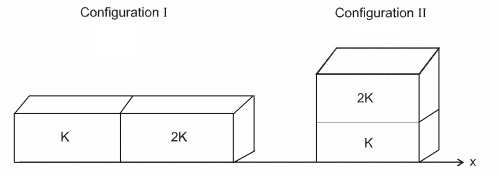
Two rectangular blocks, having indentical dimensions, can be arranged either in configuration $I$ or in configuration $II$ as shown in the figure, On of the blocks has thermal conductivity $k$ and the other $2 \ k$. The temperature difference between the ends along the $x$-axis is the same in both the configurations. It takes $9\ s$ to transport a certain amount of heat from the hot end to the cold end in the configuration $I$. The time to transport the same amount of heat in the configuration $II$ is :
What percentage of kinetic energy of a moving particle is transferred to a stationary particle when it strikes the stationary particle of $5$ times its mass? (Assume the collision to be head-on elastic collision)
The coefficient of linear expansion of crystal in one direction is ${\alpha _1}$ and that in every direction perpendicular to it is ${\alpha _2}$. The coefficient of cubical expansion is
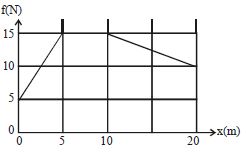
Figure here shows the frictional force versus displacement for a particle in motion. The loss of kinetic energy in travelling over $s = 0$ to $20\, m$ will be......$J$
A public park, in the form of a square, has an area of $(100 \pm 0.2) m ^2$. The side of park is ......... $m$