MCQ
The overall complex dissociation equilibrium constant for the complex $[Cu(NH_3)_4]^{2+}$ ion will be ( $\beta _4$ for this complex is $2.1\times 10^{13}$ ) $\beta _4 =$ association constant
  • $4.7\times 10^{-14}$
  • B
    $2.1\times 10^{13}$
  • C
    $11.9\times 10^{-2}$
  • D
    $2.1\times 10^{-13}$

Answer

Correct option: A.
$4.7\times 10^{-14}$
a
$\mathrm{K}=\frac{1}{\beta_{4}} $

$=\frac{1}{2.1 \times 10^{13}} $

$=4.7 \times 10^{-14}$

Need a full question paper?

Generate a complete, print-ready paper with questions like this in minutes — across 16+ boards, with answer keys.

Start Generating Free

Similar questions

An element $(X)$ forms compounds of the formula $XC{l_3},$ ${X_2}{O_5}$ and $C{a_3}{X_2},$ but does not form $XC{l_5}$, which of the following is the element $X$
Which of the following is heterocyclic aromatic compound ?
Amongst $TiF_6^{2-}$ , $CoF_6^{3-}$ , $Cu_2Cl_2$ and $NiCl_4^{2-}$ the colourless species are
Which one of the following molecule will form a linear polymeric structure due to $H-$ Bonding
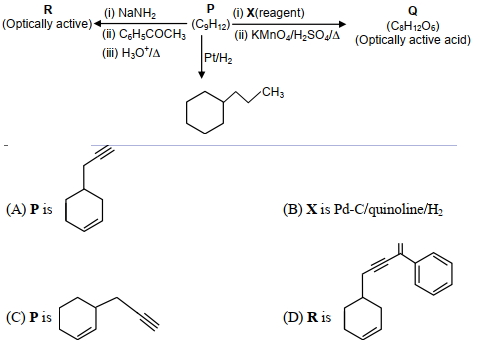
Consider the following transformations of a compound $P$.

(image)

Choose the correct option($s$).

(image)

The amount of energy released on the addition of an electron in outermost shell of an  atom is called 
Match List $I$ w1th List $II$

LIST $I$

(Precipitating reagent and

conditions)

LIST $II$

(Cation)

$A$ $\mathrm{NH}_4 \mathrm{Cl}+\mathrm{NH}_4 \mathrm{OH}$ $I$ $\mathrm{Mn}^{2+}$
$B$ $\mathrm{NH}_4 \mathrm{OH}+\mathrm{Na}_2 \mathrm{CO}_3$ $II$ $\mathrm{Pb}^{2+}$
$C$ $\mathrm{NH}_4 \mathrm{OH}+\mathrm{NH}_4 \mathrm{Cl}+\mathrm{H}_2 \mathrm{~S}$ gas $III$ $\mathrm{Al}^{3+}$
$D$ dilute $\mathrm{HCl}$ $IV$ $\mathrm{Sr}^{2+}$

Choose the correct answer from the options given below:

$C_2$ -epimer of $D$ -Glucose is
The number of atoms in $8\, \mathrm{~g}$ of sodium is $\mathrm{x} \times 10^{23}.$ The value of $\mathrm{x}$ is ...... .(Nearest integer)

$\left[\right.$ Given $: \mathrm{N}_{\mathrm{A}}=6.02 \times 10^{23}\, \mathrm{~mol}^{-1}$, Atomic mass of $\mathrm{Na}=23.0\, \mathrm{u}]$

Assertion : Copper metal gets readily corroded in an acidic aqueous solution.

Reason : Free energy change for this process is positive.