MCQ
The pair of amphoteric hydroxides is
  • A
    $Al{(OH)_3},\;LiOH$
  • B
    $Be{(OH)_2},\;Mg{(OH)_2}$
  • C
    $B{(OH)_3},\;Be{(OH)_2}$
  • $Be{(OH)_2},\;Zn{(OH)_2}$

Answer

Correct option: D.
$Be{(OH)_2},\;Zn{(OH)_2}$
d
(d) Both $Be(OH)_2$ and $Zn(OH)_2$ are amphoteric in nature.

Need a full question paper?

Generate a complete, print-ready paper with questions like this in minutes — across 16+ boards, with answer keys.

Start Generating Free

Similar questions

$2C + {O_2} \to 2CO;\,\,\Delta H = - 220\,kJ$ Which of the following statement is correct for this reaction
Copper from copper sulphate solution can be displaced by .............. The standard reduction potentials of some electrodes are given below

$E^o (Fe^{+2}, Fe) = -0.44$ $ V$

$E^o (Zn^{+2}, Zn) = -0.76$ $ V$

$E^o (Cu^{+2}, Cu) = +0.34$ $V$

$E^o (Cr^{+2}, Cr) = -0.74$  $V$

$E^o (H^+, 1/2H_2) = -0.00$ $V$
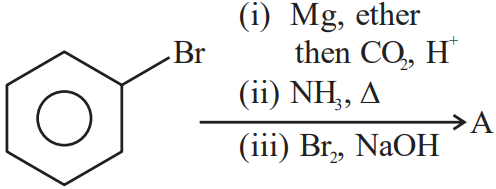
The final product A, formed in the following multistep reaction sequence is: 

Image
Number of moles of $\mathrm{H}^{+}$ions required by $1 \mathrm{~mole}$ of $\mathrm{MnO}_4^{-}$to oxidise oxalate ion to $\mathrm{CO}_2$ is . . .. . . 
Which of the following halogens doesn’t exhibit positive oxidation state in its compounds
For the following reactions, equilibrium constants are given

$S\left( s \right) + {O_2}\left( g \right) \rightleftharpoons S{O_2}\left( g \right);{K_1} = {10^{52}}$

$2S\left( s \right) + 3{O_2}\left( g \right) \rightleftharpoons 2S{O_3}\left( g \right);{K_2} = {10^{129}}$

The equilibrium constant for the reaction $2S{O_2}\left( g \right) + {O_2}\left( g \right) \rightleftharpoons 2S{O_3}\left( g \right)$ is

Which of the following is not correct for given reaction

$Xe{F_6}\,\xrightarrow{{ + {H_2}O}}A\,\xrightarrow{{ + {H_2}O}}B\,\xrightarrow{{ + {H_2}O}}C$

The concentrated sulphuric acid that is peddled commercial is $95\%\,\,H_2SO_4$ by weight . If the density of this commercial acid is $1.834\,g\,cm^{-3},$ the molarity of this solution is ........... $\mathrm{M}$
${Image}$

In the above chemical reaction, intermediate $"X"$ and reagent/condition $"A"$ are

Which one of the following compounds cannot be prepared by Wurtz reaction