MCQ
The path Difference between the two waves ${y_1} = {a_1}\,\sin \,\left( {\omega t - \frac{{2\pi x}}{\lambda }} \right)$ and ${y_2} = {a_2}\,\cos \,\left( {\omega t - \frac{{2\pi x}}{\lambda } + \phi } \right)$ is
  • A
    $\frac{\lambda }{{2\pi }}\,\phi $
  • B
    $\frac{\lambda }{{2\pi }}\,\left( {\phi  - \frac{\pi }{2}} \right)$
  • $\frac{\lambda }{{2\pi }}\,\left( {\phi  + \frac{\pi }{2}} \right)$
  • D
    $\frac{{2\pi }}{\lambda }\,\phi $

Answer

Correct option: C.
$\frac{\lambda }{{2\pi }}\,\left( {\phi  + \frac{\pi }{2}} \right)$
c
$y_{1}=a_{1} \sin \left(\omega t-\frac{2 \pi x}{\lambda}\right)$

$\mathrm{y}_{2}=\mathrm{a}_{2} \sin \left(\omega \mathrm{t}-\frac{2 \pi \mathrm{x}}{\lambda}+\frac{\pi}{2}+\phi\right)$

$\Delta \phi=\frac{\pi}{2}+\phi$

So, $\frac{\Delta \phi}{2 \pi}=\frac{\Delta x}{\lambda} \Rightarrow \Delta x=\frac{\lambda}{2 \pi}\left(\frac{\pi}{2}+\phi\right)$

Need a full question paper?

Generate a complete, print-ready paper with questions like this in minutes — across 16+ boards, with answer keys.

Start Generating Free

Similar questions

The potential energy of a certain particle is given by $U = \frac{1}{2}\,\left( {{x^2} - {z^2}} \right)$. The force on it is 
If given wave has propagation constant $\frac{5 \pi}{7}\, rad/m$ then phase difference between two particle having distance difference $\frac{49}{22} \,m$ is ..... $rad.$
A metal rod of cross-sectional area $10^{-4} \,m ^{2}$ is hanging in a chamber kept at $20^{\circ} C$ with a weight attached to its free end. The coefficient of thermal expansion of the rod is $2.5 \times 10^{-6} \,K ^{-1}$ and its Young's modulus is $4 \times 10^{12} \,N / m ^{2}$. When the temperature of the chamber is lowered to $T$, then a weight of $5000 \,N$ needs to be attached to the rod, so that its length is unchanged. Then, $T$ is ............ $^{\circ} C$
A particle is moving with uniform speed along the circumference of a circle of radius $R$ under the action of a central fictitious force $F$ which is inversely proportional to $R ^{3}$. Its time period of revolution will be given by
A particle moving with uniform speed in a circular path maintains:
A point starts moving in a straight line with a certain acceleration. At a time $t$after beginning of motion the acceleration suddenly becomes retardation of the same value. The time in which the point returns to the initial point is
Given below are two statements :

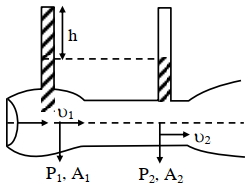
Statement $I$ : When speed of liquid is zero everywhere, pressure difference at any two points depends on equation $\mathrm{P}_1-\mathrm{P}_2=\rho \mathrm{g}\left(\mathrm{h}_2-\mathrm{h}_1\right)$

Statement $II$ : In ventury tube shown $2 \mathrm{gh}=v_1^2-v_2^2$

In the light of the above statements, choose the most appropriate answer from the options given below.

Maximum value of static friction is called
Match List-I with List-II and select the correct answer by using the codes given below the lists
List - I List - II
 $(A)$ Distance between earth and stars  $(1)$ Microns
 $(B)$ Inter-atomic distance in a solid  $(2)$ Angstroms
$(C)$ Size of the nucleus    $(3)$ Light years
 $(D)$ Wavelength of infrared laser $(4)$ Fermi
  $(5)$ Kilometres
When a train approaches a stationary observer, the apparent frequency of the whistle is $n'$  and when the same train recedes away from the observer, the apparent frequency is $n''.$  Then, the apparent frequency $n$  when the observer moves with the train is