Question
The path executed by a charged particle whose motion is perpendicular to magnetic field i(a) A straight line(b) An ellipse(c) A circle(d) A helix
       

Answer

(c) A circle

Need a full question paper?

Generate a complete, print-ready paper with questions like this in minutes — across 16+ boards, with answer keys.
Start Generating Free

Similar questions

Gravitational force has only on sign but coulomb force has:
In an experiment of photoelectric effect the number of photoelectrons has to be increased without changing their frequency. The suitable step to be taken about the incident radiation for this is:
When the intensity of a light source is increased:
Ultraviolet rays coming from sun are absorbed by:
The alloys constantan and manganin are used to make standard resistance due to they have(a) Low resistivity(b) High resistivity(c) Low temperature coefficient of resistance(d) Both (b) and (c)
   
   
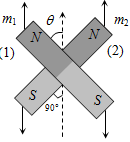
Two magnets of equal mass are joined at right angles to each other as shown the magnet $1$ has a magnetic moment $3$ times that of magnet $2.$ This arrangement is pivoted so that it is free to rotate in the horizontal plane. In equilibrium what angle will the magnet $1$ subtend with the magnetic meridian
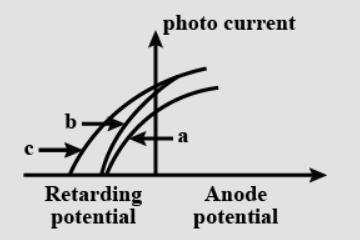
The figure shows a plot of photocurrent v/s anode potential for a photo sensitive surface for three different radiations. Which one of the following is a correct statement?
An electric bulb is rated 220 volt and 100 watt. Power consumed by it when operated on 110 volt is(a) 50 watt(b) 75 watt(c) 90 watt(d) 25 watt
       
In the experiment of diffraction at a single slit, if the slit width is decreased, the width of the central maximum(a) Increases in both Fresnel and Fraunhofer diffraction(b) Decreases both in Fresnal and Fraunhofer diffraction (c) Increases in Fresnel diffraction but decreases in Fraunhofer diffraction(d) Decreases in Fresnel diffraction but increases is Fraunofer diffraction.


Avalanche breakdown is due to(a) Collision of minority charge carrier(b) Increase in depletion layer thickness (c) Decrease in depletion layer thickness (d) None of these