MCQ
The path of planet around a star is:
  • A
    Circle
  • Ellipse
  • C
    Parabola
  • D
    Hyperbola

Answer

Correct option: B.
Ellipse
B

Need a full question paper?

Generate a complete, print-ready paper with questions like this in minutes — across 16+ boards, with answer keys.
Start Generating Free

Similar questions

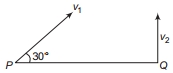
A projectile $A$ is thrown at an angle $30^{\circ}$ to the horizontal from point $P$. At the same time another projectile $B$ is thrown with velocity $v_2$ upwards from the point $Q$ vertically below the highest point $A$ would reach. For $B$ to collide with $A$, the ratio $\frac{v_2}{v_1}$ should be
If the specific heats per gram of an ideal gas of molecular weight M are represented by Cp and $C _{ \text v }$ then :
One end of a metal rod of length $1.0 m$ and area of cross section $100c{m^2}$ is maintained at ${100^o}C.$If the other end of the rod is maintained at ${0^o}C$, the quantity of heat transmitted through the rod per minute is (Coefficient of thermal conductivity of material of rod =$100W/m-K$)
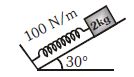
A block of mass $2\,\,kg$ is placed on a rough inclined plane as shown in the figure $(\mu  = 0.2)$ so that it just touches the spring. The block is allowed to move downwards. The spring will be compressed to a maximum of
A mass of $1 \;kg$ is thrown up with a velocity of $100 \;m / s$. After $5 \;seconds$, it explodes into two parts. One part of mass $400\; g$ comes down with a velocity $25 \;m / s$ Calculate the velocity of other part
The reason for the change in shape of a regular body is
If the ratio of amplitude of wave is $2 : 1$, then the ratio of maximum and minimum intensity is
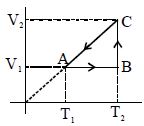
A cyclic process for $1\,mole$ of an ideal gas is shown. Find work done in $AB, BC$ and $CA$ respectively
A car starts from rest and accelerates at $5 \,\mathrm{~m} / \mathrm{s}^{2}$. At $t=4 \mathrm{~s}$, a ball is dropped out of a window by a person sitting in the car. What is the velocity and acceleration of the ball at $\mathrm{t}=6\, \mathrm{~s}$ ?

(Take g $\left.=10\, \mathrm{~m} / \mathrm{s}^{2}\right)$

Two cylindrical vessels of equal cross-sectional area $16\,cm ^{2}$ contain water upto herghts $100\,cm$ and $150\,cm$ respectively. The vessels are interconnected so that the water levels in them become equal. The work done by the force of gravity during the process, is $......J$ [Take density of water $=10^{3}\,kg / m ^{3}$ and $g =10\,ms ^{-2}$ ]