The perimeter of an isosceles right triangle having area $100 cm^2$ is


Download our appand get started for free
Experience the future of education. Simply download our apps or reach out to us for more information. Let's shape the future of learning together!No signup needed.*
Similar Questions
- 1View SolutionThe area of an equilateral triangle with perimeter 12 cm is
- 2The sides of a triangular field are $325m, 300m$ and $125m$. Its area is:View Solution
- 3View SolutionEach side of a triangle is multiplied with the sum of the squares of the other two sides. If the sum of all such possible results is 6 times the product of the sides, then the triangle must be
- 4The lengths of the sides of $\triangle A B C$ are consecutive integers. It $\triangle A B C$ has the same perimeter as an equilateral triangle with a side of length 9 cm , what is the length of the shortest side of $\triangle A B C ?$View Solution
- 5If the area of an isosceles right triangle is $8cm^2$, what is the perimeter of the triangle?View Solution
- 6If the length of a median of an equilateral triangle is $x\ cm$, then its area is:View Solution
- 7Area of a right-angled triangle is $6 cm^2$ and its perimeter is 12 cm. Then length of its hypotenuse, isView Solution
- 8The base and hypotenuse of a right triangle are respectively $5\ cm$ and $13\ cm$ long. Its area is:View Solution
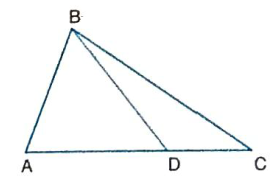
- 9In Figure, the ratio of $A D$ to $D C$ is 3 to 2. If the area of $\triangle A B C$ is $40 cm^2$, what is the area of $\triangle B D C$?View Solution
- 10View SolutionThe base and hypotenuse of a right triangle are respectively 5 cm and 13 cm long. Its area is