The period of oscillation of a simple pendulum is $T=2\pi \sqrt {\frac{l}{g}} $. Measured value of $L$ is $20.0\; cm$ known to $1\; mm$ accuracy and time for $100$ oscillations of the pendulum is found to be $90\ s$ using a wrist watch of $1\; s$ resolution. The accuracy in the determination of $g$ is ........ $\%$
JEE MAIN 2015, Easy


Download our appand get started for free
Experience the future of education. Simply download our apps or reach out to us for more information. Let's shape the future of learning together!No signup needed.*
Similar Questions
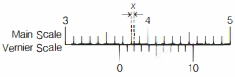
- 1The figure of a centimetre scale below shows a particular position of the Vernier calipers. In this position, the value of $x$ shown in the figure is .......... $cm$ (figure is not to scale)View Solution
- 2If force $(F),$ velocity $(V)$ and time $(T)$ are taken as fundamental units, then the dimensions of mass areView Solution
- 3A metal wire has mass $(0.4 \pm 0.002)\,g$, radius $(0.3 \pm 0.001)\,mm$ and length $(5 \pm 0.02) \,cm$. The maximum possible percentage error in the measurement of density will nearly be $.......\%$View Solution
- 4View SolutionDimensional formula for volume elasticity is
- 5View SolutionWhich is not a unit of electric field
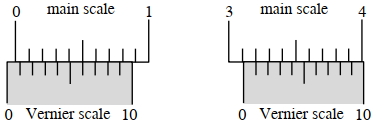
- 6The smallest division on the main scale of a Vernier calipers is $0.1 \ cm$. Ten divisions of the Vernier scale correspond to nine divisions of the main scale. The figure below on the left shows the reading of this calipers with no gap between its two jaws. The figure on the right shows the reading with a solid sphere held between the jaws. The correct diameter of the sphere isView Solution
- 7View SolutionWhich of the following is a dimensional constant?
- 8The unit of $e.m.f.$ isView Solution
- 9$Assertion$: In the measurement of physical quantities direct and indirect methods are used.View Solution
$Reason$ : The accuracy and precision of measuring instruments along with errors in measurements should be taken into account, while expressing the result.
- 10What is the fractional error in $g$ calculated from $T = 2\pi \sqrt {l/g} $ ? Given fraction errors in $T$ and $l$ are $ \pm x$ and $ \pm y$ respectively?View Solution