MCQ
The period of revolution of planet $A$ around the sun is $8$ times that of $B$. The distance of $A$ from the sun is how many times greater than that of $B$ from the sun
  • A
    $2$
  • B
    $3$
  • $4$
  • D
    $5$

Answer

Correct option: C.
$4$
c
(c) $\frac{{{T_A}}}{{{T_B}}} = {\left( {\frac{{{r_A}}}{{{r_B}}}} \right)^{3/2}}$

$ \Rightarrow 8 = {\left( {\frac{{{r_A}}}{{{r_B}}}} \right)^{3/2}}$

$ \Rightarrow {r_A} = {(8)^{2/3}}{r_B} = 4{r_B}.$

Need a full question paper?

Generate a complete, print-ready paper with questions like this in minutes — across 16+ boards, with answer keys.
Start Generating Free

Similar questions

There is no change in the volume of a wire due to change in its length on stretching. The poisson's ratio of the material of the wire is
Two forces having magnitude $A$ and $\frac{ A }{2}$ are perpendicular to each other. The magnitude of their resultant is
A $2 \mathrm{~kg}$ brick begins to slide over a surface which is inclined at an angle of $45^{\circ}$ with respect to horizontal axis. The co-efficient of static friction between their surfaces is:
Using dimensional analysis, the resistivity in terms of fundamental constants $h, m_{e}, c, e, \varepsilon_{0}$ can be expressed as
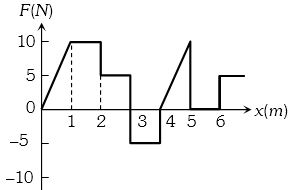
The relationship between the force $F$ and position $x$ of a body is as shown in figure. The work done in displacing the body from $x = 1$ m to $x = 5 $ m will be ........ $J$
A force $\vec F\, = \,2\hat i\,\, - \,3\hat j\, + 7\hat k\,(N)$ acts on a particle which undergoes a displacement of $\vec S\, = \,7\hat i\,\, + \,3\hat j\, - 2\hat k\,(m)$ . Calculate the work done by force ................ $\mathrm{J}$
Column $I$ Contains a list of processes involving expansion of an ideal gas. Match this with Column $II$ describing the thermodynamic change during this process. Indicate your answer by darkening the appropriate bubbles of the $4 \times 4$ matrix given in the $ORS$.
Column $I$ Column $II$
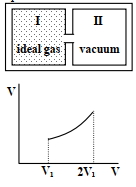
$(A)$ An insulated container has two chambers separated by a valve. Chamber $I$ contains an ideal gas and the Chamber $II$ has vacuum. The valve is opened. $(p)$ The temperature of the gas decreases
$(B)$ An ideal monoatomic gas expands to twice its original volume such that its pressure $\mathrm{P} \propto \frac{1}{\mathrm{~V}^2}$, where $\mathrm{V}$ is the volume of the gas $(q)$ The temperature of the gas increases or remains constant
$(C)$ An ideal monoatomic gas expands to twice its original volume such that its pressure $\mathrm{P} \propto \frac{1}{\mathrm{~V}^{4 / 3}}$, where $\mathrm{V}$ is its volume $(r)$ The gas loses heat
$(D)$ An ideal monoatomic gas expands such that its pressure $\mathrm{P}$ and volume $\mathrm{V}$ follows the behaviour shown in the graph $Image$ $(s)$ The gas gains heat

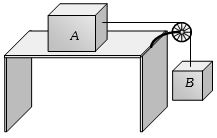
The blocks $A$ and $B$ are arranged as shown in the figure. The pulley is frictionless. The mass of $A$ is $10 \,kg$. The coefficient of friction of $A$ with the horizontal surface is $0.20$. The minimum mass of $B $ to start the motion will be...... $kg$ 
Certain neutron stars are believed to be rotating at about $1\,rev/\sec $. If such a star has a radius of $ 20\, km$, the acceleration of an object on the equator of the star will be
What is the angular velocity of earth