MCQ
The phase of a particle executing simple harmonic motion is $\frac{\pi }{2}$ when it has
  • A
    Maximum velocity
  • B
    Maximum acceleration
  • C
    Maximum displacement
  • Both (b) and (c)

Answer

Correct option: D.
Both (b) and (c)
d
(d) For $S.H.M.$ displacement $y = a\sin \omega \,t$ and acceleration $A = \, - {\omega ^2}y\sin \omega \,t$ these are maximum at $\omega \,t = \frac{\pi }{2}.$

Need a full question paper?

Generate a complete, print-ready paper with questions like this in minutes — across 16+ boards, with answer keys.
Start Generating Free

Similar questions

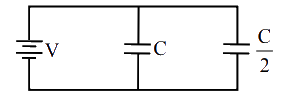
Two condensers, one of capacity $C$ and other of capacity $C/2$ are connected to a $V-$ volt battery, as shown in the figure. The work done in charging fully both the condensers is
The frequency of a rod is $200 Hz$. If the velocity of sound in air is $340\,m{s^{ - 1}}$, the wavelength of the sound produced is
Characteristic $X-$ rays 
A particle of mass $200 \,g$, is whirled into a vertical circle of radius $80 \,cm$ using a massless string. The speed of the particle when the string makes an angle of $60^{\circ}$ with the vertical line is $1.5 \,ms ^{-1}$. The tension in the string at this position is ........... $N$
Assuming the coefficient of friction between the road and tyres of a car to be $0.5$, the maximum speed with which the car can move round a curve of $40.0\, m$ radius without slipping, if the road is unbanked, should be ......... $m/s$
A block slides down an inclined plane of slope of angle $\theta $ with a constant velocity. It is then projected up the plane with an initial velocity $u$. The distance upto which it will rise before coming to rest is
When the convergent nature of a convex lens will be less as compared with air
A particle of mass $m$ slides from rest down a plane inclined at $30^o$ to the horizontal. The force of resistance acting on the particle during motion is $ms^2$ where $s$ is the displacement of the particle from its initial position. The velocity (in $m/s$) of the particle when $s = 1\,m$ is $v$. The value of $\frac{3v^2}{14}$ is :-
$A$ man of mass $M$ stands at one end of a plank of length $L$ which lies at rest on a frictionless surface. The man walks to other end of the plank. If the mass of the plank is $\frac{M}{3}$ , then the distance that the man moves  relative to ground is :
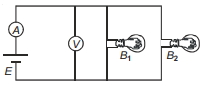
Two identical bulbs are connected in parallel across an ideal source of emf $E$. The ammeter $A$ and voltmeter $V$ are ideal. If bulb $B_2$ gets fused, then