MCQ
The physical quantities not having same dimensions are
  • A
    Speed and ${({\mu _0}{\varepsilon _0})^{ - 1/2}}$
  • B
    Torque and work
  • Momentum and Planck's constant
  • D
    Stress and Young's modules

Answer

Correct option: C.
Momentum and Planck's constant
c
(c) Momentum $[ML{T^{ - 1}}]$, Planck's constant $[M{L^2}{T^{ - 1}}]$

Need a full question paper?

Generate a complete, print-ready paper with questions like this in minutes — across 16+ boards, with answer keys.
Start Generating Free

Similar questions

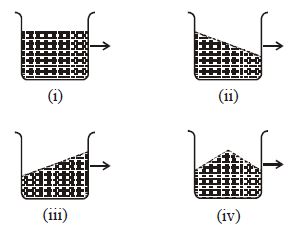
A vessel containing water is moving with a constant speed towards right along a straight horizontal path. Which of the following diagrams represents the surface of liquid?
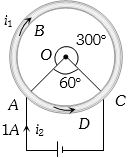
A cell is connected between the points $A$ and $C$ of a circular conductor $ABCD$ of centre $O$ with angle $AOC = {60^o}$. If ${B_1}$ and ${B_2}$ are the magnitudes of the magnetic fields at $O$ due to the currents in $ABC$ and $ADC$ respectively, the ratio $\frac{{{B_1}}}{{{B_2}}}$ is
A charged particle of charge $q$ and mass $m$, gets deflected through an angle $\theta$ upon passing through a square region of side $a$, which contains a uniform magnetic field $B$ normal to its plane. Assuming that the particle entered the square at right angles to one side, what is the speed of the particle?
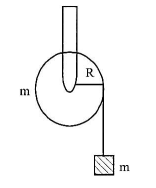
A mass m is supported by a massless string wound around a uniform hollow cylinder of mass m and radius R. If the string does not slip on the cylinder, with what acceleration will the mass fall or release?
Image
Monochromatic light with a frequency well above the cutoff frequency is incident on the emitter in a photoelectric effect apparatus. The frequency of the light is then doubled while the intensity is kept constant. How does this affect the photoelectric current?
A thick plane mirror shows a number of images of the filament of an electric bulb. Of these, the brightest image is the
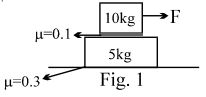
The acceleration of $10\, kg$ block when $F = 30\,N$ ........ $m/s^2$
Two bodies are in equilibrium when suspended in water from the arms of a balance. The mass of one body is $36 g $ and its density is $9 g / cm^3$. If the mass of the other is $48 g$, its density in $g / cm^3$ is
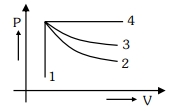
An ideal gas undergoes four different processes from the same initial state as shown in the figure below. Those processes are adiabatic, isothermal, isobaric and isochoric. The curve which represents the adiabatic process among $1,2,3$ and $4$ is
The maximum magnification that can be obtained with a convex lens of focal length $2.5\, cm$ is (the least distance of distinct vision is $25 \,cm$)