Question
The physicists think at a level far higher than a normal individual. Explain.

Answer

For progress every leader has to be a thinker at a higher level in his field than ordinary man. This is more so in case of physicists as the technological development meant for uplifting the living condition of mankind is dependent on the far sight of the physicists in particular. The physicist must think at a level which is philosophical and mathematically quantifying so that they can visualize the requirement of people at least a quarter of century in advance.

Need a full question paper?

Generate a complete, print-ready paper with questions like this in minutes — across 16+ boards, with answer keys.
Start Generating Free

Similar questions

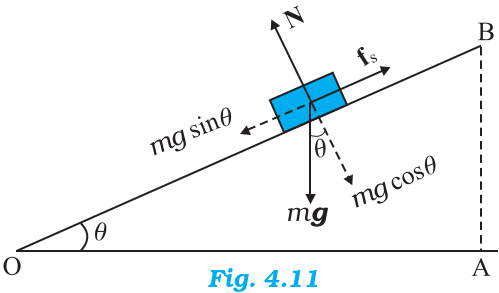
See Fig. 4.11. A mass of 4 kg rests on a horizontal plane. The plane is gradually inclined until at an angle θ = 15° with the horizontal, the mass just begins to slide. What is the coefficient of static friction between the block and the surface ?
Image
Suppose the average mass of raindrops is $3.0 \times 10^{-5} kg$ and their average terminal velocity $9 m s { }^{-1}$. Calculate the energy transferred by rain to each square metre of the surface at a place which receives 100 cm of rain in a year.
Temperatures of the hot and cold reservoirs of a Carnot engine is raised by equal amounts. How the efficiency of the Carnot engine affected?
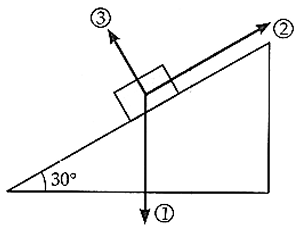
A block of wood of mass 3 kg is resting on the surface of a rough inclined surface, inclined at an angle $\theta$ as shown in the figure.
Image
a. Name the forces $(1,2,3)$.
b. If the coefficient of static friction is 0.2 , calculate the value of all three forces.
$
\text { (use } g=10 m / s^2 \text { ) }
$
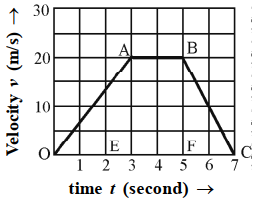
Q. 13. Draw a time graph for a vehicle from the time-velocity graph given in the attached figure.
Image
If ice on poles melts, then what is the change in duration of day?
The mass of a spaceship is $1000kg$. It is to be launched from the earth's surface out into free space. The value of g and R (radius of earth) are $10m/ s^2$ and $6400km$, respectively. What is the required energy for this work done?
Calculate the heat required to convert $3kg$ of ice at $-12^\circ C$ kept in a calorimeter to steam at $100^\circ C$ at atmospheric pressure.
Given specific heat capacity of ice $= 2100 \ J \ kg^{-1} \ K^{-1}$,
specific heat capacity of water $= 4186 \ J \ kg^{-1}\ K^{-1}$,
latent heat of fusion of ice $= 3.35 \times 10^5  \ J \ kg^{-1}$
and latent heat of steam $= 2.256 \times 10^6 \ J \ kg^{-1}$. (No heat is absorbed by the calorimeter).
A hydrogen atom in state $n = 6$ makes two successive transitions and reaches the ground state. In the first transition a photon of $1.13eV$ is emitted. $(a)$ Find the energy of the photon emitted in the second transition $(b)$ What is the value of n in the intermediate state?
Two bodies are thrown with the same initial velocity at angles $\alpha$ and $(90^\circ-\alpha)$ with and is of horizontal. What will be the ratio of (i) maximum heights attained by them and (ii) of horizontal ranges?