Question
The $\pi$-complexes are known for transition metals only. Why?

Answer

Transition metals have vacant d-orbitals in their atoms or ions into which the electron pairs can be donated by ligands containing $\pi$-electrons, e.g., $C_6H_6, CH_2=CH_2$, etc. Thus, $\text{d}$$\pi$ – $\text{p}\pi$ bonding is possible.

Need a full question paper?

Generate a complete, print-ready paper with questions like this in minutes — across 16+ boards, with answer keys.

Start Generating Free

Similar questions

Calculate the distance between $Na^+$ and $Cl^-$ ions in $NaCl$ crystal if its density is $2.165\ g\ cm^{-3}. [$Molar mass of $NaCl=58.5\ g\ mol^{-1};\ N_A=6.02 x 10^{-23}\ mol^{-1}].$
  1. Based on the nature of intermolecular forces, classify the following solids:
Silicon carbide, Argon
  1. $ZnO$ turns yellow on heating. Why?
  2. What is meant by groups $12-16$ compounds? Give an example.
Discuss the trends in chemical reactivity of group $15$ elements.
Explain how the phenomenon of adsorption finds application in each ofthe following processes:
  1. Production of vacuum.
  2. Heterogeneous catalysis.
  3. Froth Floatation process.
Write the Nernst equation and emf of the following cells at $298\ K:$
$Pt(s) | Br_2(l) | Br^– (0.010 M) || H^+ (0.030 M) | H_2(g) (1 bar)|Pt(s).$
Match the items of column I with items of column II.
 
Column I
 
Column II
(i)
Methanol
(a)
Conversion of phenol to o-hydroxysalicylic acid
(ii)
Kolbe’s reaction
(b)
Ethyl alcohol
(iii)
Williamson’s synthesis
(c)
Conversion of phenol to salicylaldehyde
(iv)
Conversion of $2°$ alcohol to ketone
(d)
Wood spirit
(v)
Reimer-Tiemann reaction
(e)
Heated copper at $573K$
(vi)
Fermentation
(f)
Reaction of alkyl halide with sodium alkoxide
How would you account for the following:
i. Phenols are much more acidic than alcohols.
ii. The boiling point of ethers are much lower than those of the alcohols of comparable molar masses.
Calculate the equilibrium constant for the reaction,$\text{Cd}^{2+}(\text{aq})+\text{Zn(s)}\xrightarrow{ \ \ \ \ \ \ \ }\text{Zn}^{2+}(\text{aq) + Cd(s)}$
If $\text{E}^{\circ}_{\text{Cd}^{2+}/\text{Cd}}=-0.403\text{V;}\text{ E}^{\circ}_{\text{Zn}^{2+}/\text{Zn}}=-0.763\text{V}$
Calculate the charge of one mole of electrons.
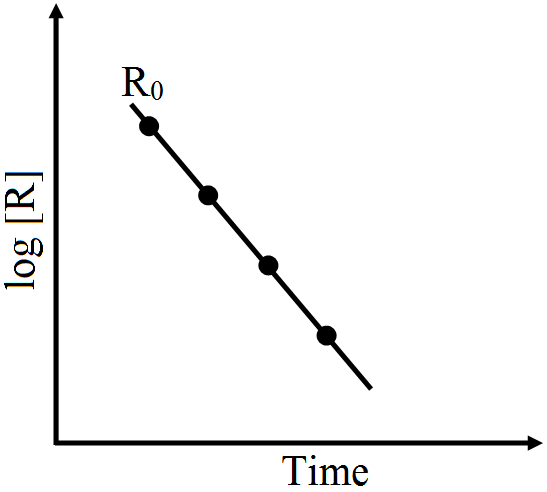
Observe the graph in diagram and answer the following questions.
  1. If slope is equal to $-2.0 \times 10^{-6} \sec^{-1}$, what will be the value of rate constant?
  2. How does the half-life of zero order reaction relate to its rate constant?