Question
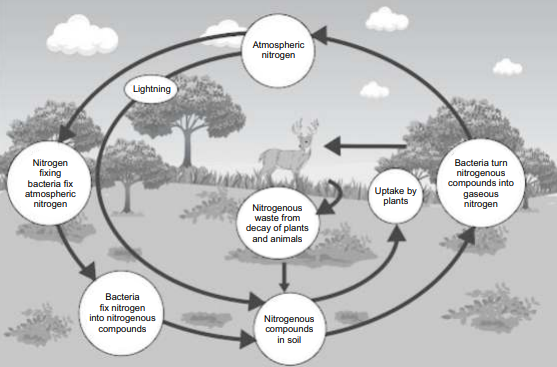
The picture shows the nitrogen cycle.
Image
$9.$ How do plants take up nitrogen$?$
$A.$ She should repeat the same experiment.
$B.$ She should leave the test tube undisturbed for six hours.
$C.$ She should repeat the experiment with test tubes containing more sugar solution.
$D.$ She should keep an extra set of test tubes with sugar solution but without the yeast.
$10.$ Plants and animals are continuously using nitrogen. Will there be a depletion of nitrogen in the environment due to this continuous use$?$ Explain your answer.
Answer

$9. C.$ From nitrogenous compounds in the soil
$10.$ Mentions that nitrogen in the environment will not get depleted because
it is recycled and reused in the environment.

Need a full question paper?

Generate a complete, print-ready paper with questions like this in minutes — across 16+ boards, with answer keys.

Start Generating Free

Similar questions

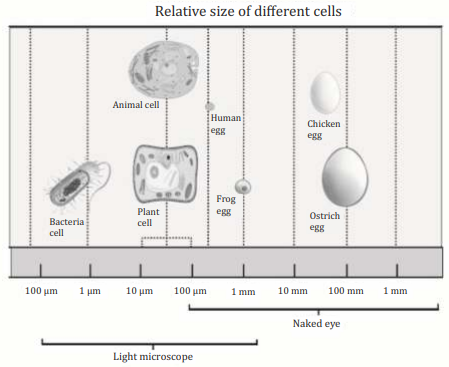
The picture shows the relative size of different types of cells between $100\ nm$ and $100\ mm.$Image
$1.$ What can be concluded from the picture?
Circle ‘Yes’ or ‘No’ for the correct response.
Can this be concluded from the picture? Yes or No
An egg is a type of cell. Yes/No
Some cells are visible to the naked eyes. Yes/No
Animal cells are much smaller than plant cells. Yes/No
$2.$ Which egg’s length cannotbe measured with a ruler$?$
$A.$ Human egg
$B.$ Frog egg
$C.$ Chicken egg
$D.$ Ostrich egg
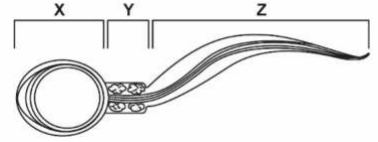
The picture shows the basic parts of a salmon ish sperm.

Image
$7.$ Which part of the sperm helps it to swim in water and reach the egg$?$
$8.$ Which of these animals reproduce by external fertilization?
$A.$ Snake
$B.$ Frog
$C.$ Horse
$D.$ Elephant
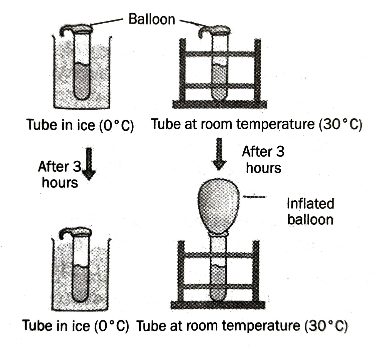
Manoj adds some yeast to two test tubes containing sugar solution. He ties balloons on the mouth of each of test tube. One test tube is kept in ice and the other at room temperature. The picture shows what happens after three hours.
Image
(i) What is Manoj investigating ?
$\quad$(a) Does yeast grow in sugar solution only ?
$\quad$(b) Does yeast convert sugar into alcohol ?
$\quad$(c) Does temperature affect the growth of yeast ?
$\quad$(d) Which gas is produced as yeast grows in sugar solution ?
(ii) How can Manoj confirm, if the gas produced in the test tube at room temperature was due to the yeast growing in it ?
$\quad$(a) He should repeat the same experiment
$\quad$(b) He should leave the test tube undisturbed for six hours
$\quad$(c) He should repeat the experiment with test tubes containing more sugar solution
$\quad$(d) He should keep an extra set of test tubes with sugar solution, but without the yeast
(iii) What should Manoj keep the same in both the test tubes for a fair experiment? Circle 'Yes' or 'No' for each row.
Should this be kept same for both the test tubes ?Yes or No
(a) The concentration of sugar solutionYes/No
(b) The colour of the balloonsYes/No
(c) The amount of yeast added to each test tubeYes/No

(iv) What type of organism is yeast ?

$\quad$(a) Fungi
$\quad$(b) Algae
$\quad$(c) Bacteria
$\quad$(d) Protozoa
The table shows two groups of natural resources.
Group 1Group 2
Air. Sunlight, WaterCoal, Petroleum, Natural gas

(i) How is group 1 different from group 2 ?
(II) Which resource in group 2 will cause the least amount of air pollution on burning ?
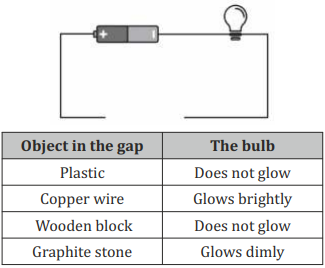
Tia used four different objects to ill the gap in an electric circuit, separately.
The table shows what she found.
Image
$1.$ Which of these best conducts electricity$?$
$A.$ Wood
$B.$ Plastic
$C.$ Copper
$D.$ Graphite
$2$. Which of these is a chemical effect of electric current$?$
$A.$ Glowing of bulb
$B.$ Heating of water
$C.$ Ringing of mobile phone
$D.$ Chromium plating on iron
$3.$ Which of these is a correct pair of an insulator and a conductor$?$
  Insulator Conductor
$A.$ Aluminium Cotton
$B.$ Thermocol Rubber
$C.$ Copper Iron
$D.$ Wax Aluminium
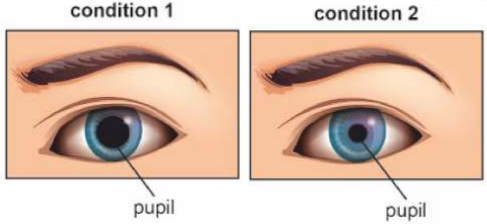
The picture shows the size of the pupil under two different conditions.Image
10. What makes the pupil change size between conditions $1$ and $2?$
A farmer wants to grow crops in his ield between the months of June and July.
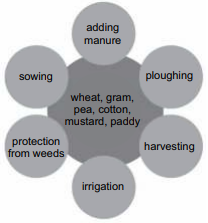
The chart below shows a list of crops and different agricultural practices.
Image
$5.$ Select two crops from the list that grow best during June and July
$6.$ The farmer prepared the soil in his ield by turning and loosening the soil.
How does turning and loosening the soil help in growing plants?
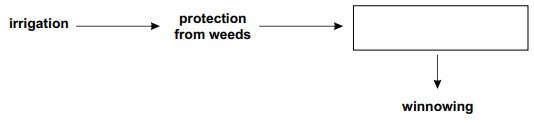
$7.$ Farmers follow a sequence of agricultural practices to grow crops. A part of the sequence is shown below.
Choose an appropriate agricultural practice from the chart above to ill in the box.
Image
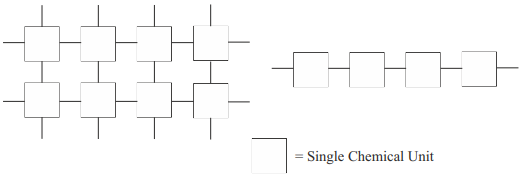
The pictures show the arrangement of chemical units in two types of plastics.Image
$7.$ What terms are used to describe the arrangement in Type $1$ and Type $2$ plastics$?$
$8.$ Which of these features is/are essential to classify a plastic as thermoplastic$?$
Circle ‘Yes’ or ‘No’ to mark your response.
Is this feature essential for classifying a plastic as thermoplastic? Yes or No
It bends easily on heating. Yes/No
It does not react with air and water Yes/No
It is a good conductor of heat. Yes/No
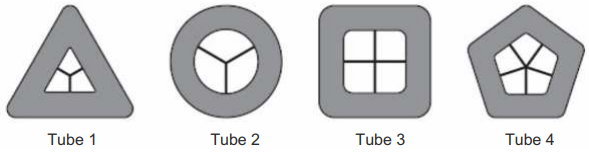
The picture shows four different rubber tubes.
Image
$5.$ Which tube will experience the least friction while rolling on a surface?
Explain your answer.
$6.$ Which of these would affect the amount of friction generated on a moving object$?$
Circle ‘Yes’ or ‘No’ for the correct response.
Does this Affect the Amount of Friction Generated? Yes or No
Mass of the object Yes/No
Surface area of the object Yes/No
Roughness of the object Yes/No


Diabetes is a condition in which the blood sugar level of a person rises above the normal level.
The table below shows the average range of blood sugar levels at fasting.
  Low blood sugar level Normal blood sugar level High blood sugar level (diabetes)
Blood sugar level at fasting below $70$ mg/dL $70 – 120$ mg/dL above $120$ mg/dL
Doctors prescribe insulin injection for patients with high blood sugar levels. However, glucagon is injected in an emergency if the blood sugar level of a person drops too low.
$9.$ Which of these is true about the gland secreting insulin in the human body$?$
$A.$ It has no ducts.
$B.$ It is located on the skin.
$C.$ It controls the function of all other glands.
$D.$ It releases hormones that help in growth.
$10. $ Under what conditions of blood sugar level is glucagon likely to be injected$?$
$A.$ below $60$ mg/dL
$B. 80–100$ mg/dL
$C. 100–120$ mg/dL
$D.$ above $120$ mg/dL