Question
The plate current in a diode is zero. It is possible that:
  1. The plate voltage is zero.
  2. The plate voltage is slightly negative.
  3. The plate voltage is slightly positive.
  4. The temperature of the filament is low.
Answer

  1. The plate voltage is zero.
  2. The plate voltage is slightly negative.
  3. The plate voltage is slightly positive.
  4. The temperature of the filament is low.

Explanation:

The plate current varies directly with the plate voltage. Therefore, if the plate voltage is zero, the plate current is also zero. Due to the same reason, if the plate voltage is negative, the plate current will be zero. Now, if the plate is slightly positive, then it may be the reason that the plate voltage is not able to reduce the effect of space charge. Hence, the current may be zero. Now, as the temperature of the filament is low, it will not be able to emit electrons and the resulting plate current will be zero. Hence, all the options are possible.

Need a full question paper?

Generate a complete, print-ready paper with questions like this in minutes — across 16+ boards, with answer keys.

Start Generating Free

Similar questions

The specific heat of a gas
A metal bal of mass $0.1\, kg$ is heated upto $500\,{}^oC$ and dropped into a vessel of heat capacity $800\, JK^{-1}$ and containing $0.5\, kg$ water. The initial temperature of water and vessel is $30\,{}^oC$. ........ $\%$ is the approximate percentage increment in the temperature of the water. [Specific heat Capacities of water and metal are, respectively $4200\, Jkg^{-1}K^{-1}$ and $400\, Jkg^{-1}K^{-1}$]
A body is projected vertically upward direction from the surface of earth. If upward direction is taken as positive, then acceleration of body during its upward and downyard jourhey are respectively
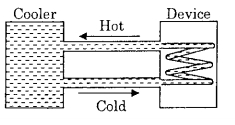
A water cooler of storage capacity $120$ litres can cool water at a constant rate of $P$ watts. In a closed circulation system (as shown schematically in the figure), tr e wat'r from the cooler is used to cool an external device that generates constantly $3 \mathrm{~kW}$ of heat (thermal load). The temperature of water fed into the device cannot exceed $30^{\circ} \mathrm{C}$ and the e.tire stored $120$ litres of water is initially cooled to $10^{\circ} \mathrm{C}$. The entire system is thermally insulat $\mathrm{d}$. The minimum value of $P$ (in watts) for which the device can be operated for $3$ hours is

(Specific heat of water is $4.2 \mathrm{~kJ}^{-1} \mathrm{~kg}^{-1}$ and the density of water is $10.$) $0 \mathrm{k}^2 \mathrm{~m}^{-3}$ )

A small object is placed at the center of a large evacuated hollow spherical container. Assume that the container is maintained at $0 K$. At time $t =0$, the temperature of the object is $200 K$. The temperature of the object becomes $100 K$ at $t = t _1$ and $50 K$ at $t = t _2$. Assume the object and the container to be ideal black bodies. The heat capacity of the object does not depend on temperature. The ratio $\left( t _2 / t _1\right)$ is. . . . . 
A sphere of mass $M$ and radius $r$ slips on a rough horizontal plane. At some instant it has translational velocity $V_0$ and rotational velocity about the centre $\frac{V_0}{2r}$  . The translational velocity when the sphere starts pure rolling motion is
The position vector of a particle is determined by the expression $\vec r = 3{t^2}\hat i + 4{t^2}\hat j + 7\hat k$ The distance traversed in first $10 \,sec$ is........ $m$
Let $[ {\varepsilon _0} ]$ denote the dimensional formula of the permittivity of vacuum. If $M =$ mass, $L=$ length, $T =$ time and $A=$ electric current, then:
A body of mass $m$ kg is lifted by a man to a height of one metre in $30\, sec$. Another man lifts the same mass to the same height in $60\, sec$. The work done by them are in the ratio
The fundamental frequency is n of both open end of argon pipe. Keep in vertical and dip in water half length of tubes. So it will full with half water the fundamental frequency of air column.