MCQ
The plot of $\log\,K$ Vs $\frac{1}{T}$ helps to calculate
  • A
    The energy of activation
  • B
    The rate constant of the reaction
  • C
    The order of reaction
  • The energy of activation as well as frequency factor

Answer

Correct option: D.
The energy of activation as well as frequency factor
d
According to Arrhenius equation

$\log k=\log A-\frac{E_a}{2.303} \cdot \frac{1}{T}$

Plot of $\log k\,vs\, \frac{1}{ T }$ is a straight line.

Slope $=-\frac{ E _{ a }}{2.303 R }$

Intercept $=\log A$

Need a full question paper?

Generate a complete, print-ready paper with questions like this in minutes — across 16+ boards, with answer keys.
Start Generating Free

Similar questions

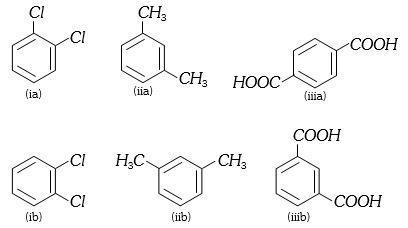
Examine the following three pairs of possible isomers Now state whether the pairs represent identical compounds or different isomers
The vapour pressure of $30 \% ( w / v )$ aqueous solution of glucose is $......\,mm\,Hg$ at $25^{\circ}\,C$.[Given : The density of $30 \%$ (w/v), aqueous solution of glucose is $1.2\,g\,cm ^{-3}$ and vapour pressure of pure water is $24\,mm\,Hg$.](Molar mass of glucose is $\left.180\,g\,mol ^{-1}.\right)$
In the following reaction 

$\begin{array}{*{20}{c}}
{C{H_3}\,\,\,\,\,\,\,\,\,\,\,}\\
{\,\,\,\,\,\,\,|\,\,\,\,\,\,\,\,\,\,\,\,\,\,\,\,\,\,\,\,\,\,\,\,\,\,}\\
{C{H_3} - C - CH = C{H_2}}\\
{\,|\,\,\,\,\,\,\,\,\,\,\,\,\,\,\,\,\,\,\,\,}\\
{C{H_3}\,\,\,\,\,\,\,\,\,\,\,\,\,} 
\end{array}$ $\xrightarrow{{{H_2}O/{H^ \oplus }}}$ $\mathop A\limits_{{\rm{(major)}}} $ + $\mathop B\limits_{{\rm{(minor)}}} $

The major product is

The Gibbs energy for the decomposition of $Al_2O_3$ at $500^o C$ is as follows :

$\frac{2}{3} Al_2O_3 \rightarrow  \frac{4}{3} Al + O_2,\,$ $\Delta G = +966\,kJ\,mol$

The potential difference needed for electrolytic reduction of $Al_2O_3$ at $500^o C$ is at least ...... $V$.

A $pH$ of $7$  signifies
What is not correct about $[Fe(H_2O)_5NO]^{+2}$ ?
The key step in cannizzaro’s reaction is the intermolecular shift of
Number of $\sigma$ and $\pi$ bonds present in ethylene molecule is respectively :
Going from fluorine to chlorine, bromine and iodine, the electronegativity
In the following reaction, which choice has value twice that of the equivalent mass of the oxidising agent