MCQ
The pointer of a dead-beat galvanometer gives a steady deflection because
  • Eddy currents are produced in the conducting frame over which the coil is wound
  • B
    Its magnet is very strong
  • C
    Its pointer is very light
  • D
    Its frame is made of abonite

Answer

Correct option: A.
Eddy currents are produced in the conducting frame over which the coil is wound
a
A galvanometer gives steady deflection.

The pointer of a dead-beat garranometer shouls steady state deflection as eddy-cumments are generated due to the coil coound. This eddy-cumment is due to the coil which is wound and produced in the conducting fuame.

Need a full question paper?

Generate a complete, print-ready paper with questions like this in minutes — across 16+ boards, with answer keys.
Start Generating Free

Similar questions

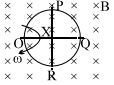
$A$ conducting ring of radius a is rotated about a point $O$ on its periphery as shown in the figure in a plane perpendicular to uniform magnetic field $B$ which exists everywhere. The rotational velocity is $\omega .$ Choose the correct statement $(s)$ related to the induced current in the ring
Water rises to a height of $10\,cm$ in a certain capillary tube. An another identical tube when dipped in mercury the level of mercury is depressed by $3.42\,cm$. Density of mercury is $13.6\, g/cc$. The angle of contact for water in contact with glass is $0^o$ and mercury in contact with glass is $135^o$. The ratio of surface tension of water to that of $Hg$ is :-
If both the object and image are at infinite distances form a refracting telescope its magnifying power will be equal to
The current flowing through a lamp marked as $50\, W$ and $250\, V$ is ............. $amp$
Given below are two statements:
Statement I: The contact angle between a solid and a liquid is a property of the material of the
solid and liquid as well.
Statement II: The rise of a liquid in a capillary tube does not depend on the inner radius of the tube.
Two wires of same diameter of the same material having the length $l$ and $2l.$ If the force $  F$ is applied on each, the ratio of the work done in the two wires will be
The key feature of Bohr's theory of spectrum of hydrogen atom is the quantization of angular momentum when an electron is revolving around a proton. We will extend this to a general rotational motion to find quantized rotational energy of a diatomic molecule assuming it to be rigid. The rule to be applied is Bohr's quantization condition.

$1.$ A diatomic molecule has moment of inertia I. By Bohr's quantization condition its rotational energy in the $\mathrm{n}^{\text {th }}$ level ( $\mathrm{n}=0$ is not allowed) is

$(A)$ $\frac{1}{\mathrm{n}^2}\left(\frac{\mathrm{h}^2}{8 \pi^2 \mathrm{I}}\right)$ $(B)$ $\frac{1}{\mathrm{n}}\left(\frac{\mathrm{h}^2}{8 \pi^2 \mathrm{I}}\right)$

$(C)$ $n\left(\frac{h^2}{8 \pi^2 \mathrm{I}}\right)$ $(D)$ $\mathrm{n}^2\left(\frac{\mathrm{h}^2}{8 \pi^2 \mathrm{I}}\right)$

$2.$ It is found that the excitation frequency from ground to the first excited state of rotation for the $\mathrm{CO}$ molecule is close to $\frac{4}{\pi} \times 10^{11} \mathrm{~Hz}$. Then the moment of inertia of $\mathrm{CO}$ molecule about its centre of mass is close to (Take $\mathrm{h}=2 \pi \times 10^{-34} \mathrm{Js}$ )

$(A)$ $2.76 \times 10^{-46} \mathrm{~kg} \mathrm{~m}^2$ $(B)$ $1.87 \times 10^{-46} \mathrm{~kg} \mathrm{~m}^2$

$(C)$ $4.67 \times 10^{-47} \mathrm{~kg} \mathrm{~m}^2$ $(D)$ $1.17 \times 10^{-47} \mathrm{~kg} \mathrm{~m}^2$

$3.$ In a $\mathrm{CO}$ molecule, the distance between $\mathrm{C}$ (mass $=12$ a.m.u) and $\mathrm{O}$ (mass $=16$ a.m.u.), where $1$ a.m.u. $=\frac{5}{3} \times 10^{-27} \mathrm{~kg}$, is close to

$(A)$ $2.4 \times 10^{-10} \mathrm{~m}$ $(B)$ $1.9 \times 10^{-10} \mathrm{~m}$

$(C)$ $1.3 \times 10^{-10} \mathrm{~m}$ $(D)$ $4.4 \times 10^{-11} \mathrm{~m}$

Give the answer question $1,2$ and $3.$

When a diode is forward biased, it has a voltage drop of $0.5\, V.$ The safe limit of current through the diode is $10\, mA$. If a battery of emf $1.5\, V$ is used in the circuit, the value of minimum resistance to be connected in series with the diode so that the current does not exceed the safe limit is$.....\Omega$
A hollow metal sphere of radius $R$ is uniformly charged. The electric field due to the sphere at a distance r from the centre
In Young's double slit experiment, the slits are $0.5\, mm$ apart and interference pattern is observed on a screen placed at a distance of $1.0\, m$  from the plane containing the slits. If wavelength of the incident light is $6000 Å$, then the separation between the third bright fringe and the central maxima is......$mm$