MCQ
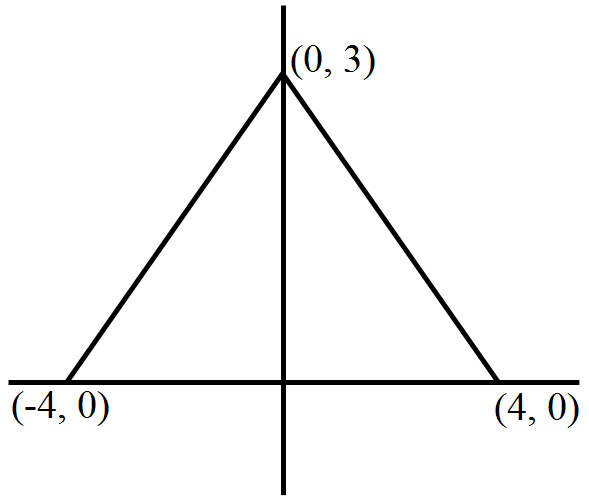
The points $(0, 3), (4, 0)$ and $(-4, 0)$ are the vertices of:
  • an isosceles triangle
  • B
    an equilateral triangle
  • C
    a right triangle
  • D
    a scalene triangle

Answer

Correct option: A.
an isosceles triangle
Let vertices of a triangle $\text{ABC}$ are $A(0, 3) B(-4, 0)$ and $C(4, 0).$
$\therefore\text{AB}=\sqrt{(-4-0)^2+(0-3)^2}$
$=\sqrt{16+9}=\sqrt{25}=\text{5 units}$
$\text{BC}=\sqrt{(4+4)^2+(0-0)^2}$
$=\sqrt{64+0}=\sqrt{25}=8\text{ units}$
$\text{AC}=\sqrt{(4-0)^2+(0-3)^2}$
$=\sqrt{16+9}=\sqrt{25}=\text{5 units}$
Since two sides are equal, therefore, $\text{ABC}$ is an isosceles triangle.

Need a full question paper?

Generate a complete, print-ready paper with questions like this in minutes — across 16+ boards, with answer keys.

Start Generating Free

Similar questions

If two positive integers $a$ and $b$ are written $a s a=x^3 y^2$ and $b=x y^3 ; x, y$ are prime numbers, then $H C F(a, b)$ is:
Directions: In the following questions, the Assertions $(A)$ and Reason$(s) (R)$ have been put forward. Read both the statements carefully and choose the correct alternative from the following:
Assertion: The value of $k$ for which the system of linear equations $kx - y = 2$ and $6x - 2y = 3$ has a unique solution is $3$.
Reason: The system of linear equations $a_1 x+b_1 y+c_1=0$ and $a_2 x+b_2 y+c_2=0$ has a unique solution if $\frac{\text{a}_1}{\text{a}_2}\ne\frac{\text{b}_1}{\text{b}_2}$
If the probability of occurrence of an event is p then the probability of non-happening of this event is:
Choose the correct answer from the given four options.
The value of $(\tan1^\circ\tan2^\circ\tan3^\circ...\tan89^\circ)$ is:
If the $2^{\text {nd }}$ term of an A.P. is 13 and $5^{\text {th }}$ term is 25 , what is its $7^{\text {th }}$ term?
The $13^{\text {th }}$ term of an $AP$ is $4$ times its $3^{\text {rd }}$ term. If its $5^{\text {th }}$ term is $16$ then the sum of its first $10$ terms is.
If the mean of first n natural numbers is $\frac{5 n}{9}$, then $n=$
The sum of the squares of two consecutive natural numbers is $41$ . Represent this situation in the form of a quadratic equation.
The volume of a cube is $2744\mathrm{~cm}^2$. Its surface area is :
Consider the following frequency distribution:
The upper limit of the median class is
Class interval1-78-1415-2122-2829-35
Frequency3105812