MCQ
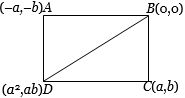
The points $( - a,\, - b),\;(0,\,0),\;(a\,,b)$ and $({a^2},ab)$ are
  • Collinear
  • B
    Vertices of a rectangle
  • C
    Vertices of a parallelogram
  • D
    None of these

Answer

Correct option: A.
Collinear
a
(a) Here area of quadrilateral is equal to area of $\Delta ABD$+area of $\Delta BCD$
$ = \left| {\begin{array}{*{20}{r}}{ - a}&{ - b}&1\\0&0&1\\{{a^2}}&{ab}&1\end{array}\,} \right| + \left| {\begin{array}{*{20}{r}}0&0&1\\a&b&1\\{{a^2}}&{ab}&1\end{array}\,} \right| = 0$

Hence the points are collinear.

Need a full question paper?

Generate a complete, print-ready paper with questions like this in minutes — across 16+ boards, with answer keys.

Start Generating Free

Similar questions

If $a$,$b$,$c \in {R^ + }$ are such that $2a$,$b$ and $4c$ are in $A$.$P$ and $c$,$a$ and $b$ are in $G$.$P$., then
If $\left| {\,a\,{{\sin }^2}\theta + b\sin \theta \cos \theta + c\,{{\cos }^2}\theta - \frac{1}{2}(a + c)\,} \right|\, \le \frac{1}{2}k,$ then ${k^2}$ is equal to
If the three normals drawn to the parabola, $y ^{2}=2 x$ pass through the point $( a , 0) a \neq 0,$ then $'a'$ must be greater than
The centre of circle inscribed in square formed by the lines ${x^2} - 8x + 12 = 0$ and ${y^2} - 14y + 45 = 0$, is
If the constant term in the expansion of $\left(3 x^{3}-2 x^{2}+\frac{5}{x^{5}}\right)^{10}$ is $2^{k} . l$, where $l$ is an odd integer, then the value of $k$ is equal to
The incorrect statement is
If the sum of three numbers of a arithmetic sequence is $15$ and the sum of their squares is $83$, then the numbers are
Complete solution set of the inequality $\left( {{{\sec }^{ - 1}}\,x - 4} \right)\left( {{{\sec }^{ 1}}\,x - 1} \right)\left( {{{\sec }^{ - 1}}\,x - 2} \right) \ge 0$ is
Let  $a,b,c\; \in R.$ If $f\left( x \right) = a{x^2} + bx + c$ is such that $a + b + c = 3$ and $f\left( {x + y} \right) = f\left( x \right) + f\left( y \right) + xy,$ $\forall x,y \in R,$ then $\mathop \sum \limits_{n = 1}^{10} f\left( n \right)$ is equal to : 
If $\tan \left(\frac{\pi}{9}\right), x, \tan \left(\frac{7 \pi}{18}\right)$ are in arithmetic progression and $\tan \left(\frac{\pi}{9}\right), y, \tan \left(\frac{5 \pi}{18}\right)$ are also in arithmetic progression, then $|x-2 y|$ is equal to: