Question
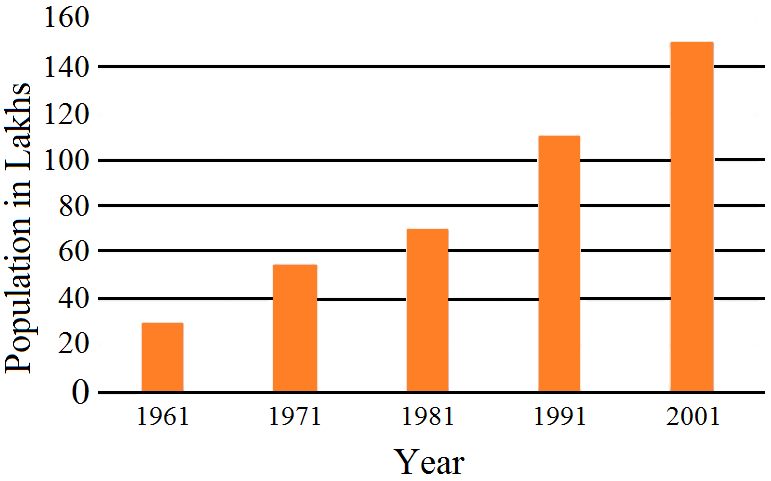
The population of Delhi State in different census years is as given below:
Census year
$1961$
$1971$
$1981$
$1991$
$2001$
Population in Lakhs
$30$
$55$
$70$
$110$
$150$
Represent the above information with the help of a bar graph.

Answer

While drawing a bar graph, we keep in mind that: The width of the bars should be uniform throughout. The gap between any two bars should be uniform throughout. Bars may be either horizontal or vertical. To represent the given data by a vertical bar graph, we first draw horizontal and vertical axes. Let us consider that the horizontal and vertical axes represent the years and the population in lakhs respectively. We have to draw 5 bars of different heights given in the table. At first, we mark $5$ points in the horizontal axis at equal distances and erect rectangles of the same width at these points. The heights of the rectangles are proportional to the population in lakhs. The vertical bar graph of the given data is following:
Note that each bar is of the same width and the gap between them is uniform. Make sure that the width of the bars and the gap between them should not be necessarily same.

Need a full question paper?

Generate a complete, print-ready paper with questions like this in minutes — across 16+ boards, with answer keys.

Start Generating Free

Similar questions

Find the missing frequencies in the follwoing frequency distribution whose mean is $34.$
$x$
$10$
$20$
$30$
$40$
$50$
$60$
Total
$f$
$4$
$f_1$​​​​​​​
$8$
$f_2​​​​​​​$
$3$
$4$
$35$
Draw the graphs of the lines $x - y = 1$ and $2x + y = 8$. Shade the area formed by these two and the $y$-axis. Also, find this area.
The expenditure (in $10$ crores of rupees) on health by the Government of India during the various five-year plans is shown below:
Plans
$I$
$II$
$III$
$IV$
$V$
$VI$
Expenditure on health(in 10 crores of rupees)
$7$
$14$
$23$
$34$
$76$
$182$
Construct a bar graph to represent the above data.
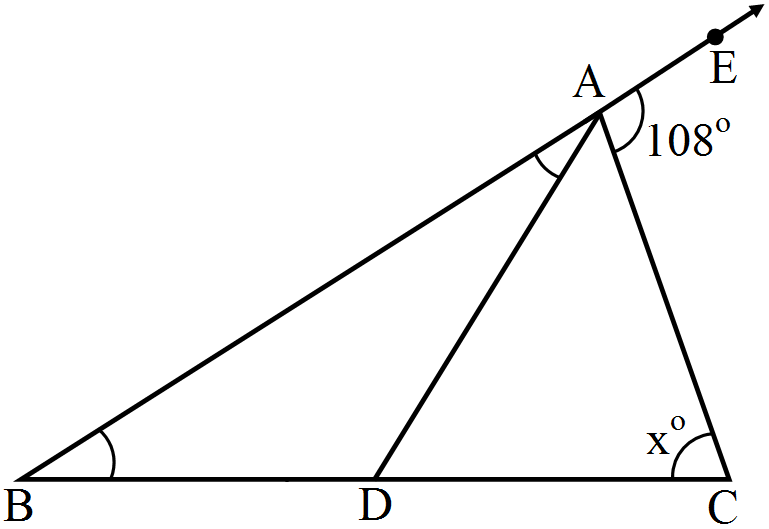
In the given figure, $AD$ divides $\angle\text{BAC}$ in the ratio $1 : 3$ and $AB = DB$. Determine the value of $x$.
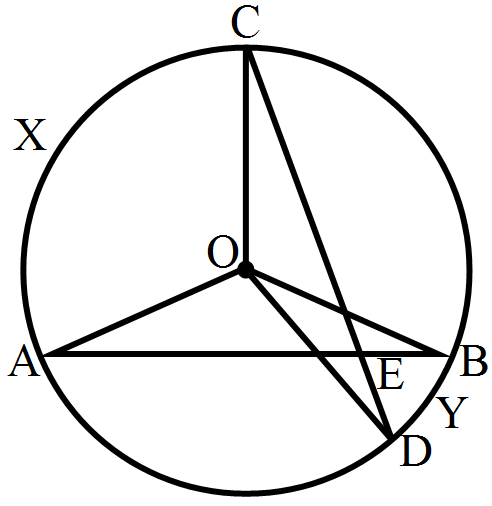
In the given figure, $AB$ and $CD$ are two chords of a circle, intersecting each other at a point $E$. Prove that $\angle\text{AEC}=\frac{1}{2}$(angle subtended by arc $CXA$ at the centre + angle subtended by arc $DYB$ at the centre).
The difference between the sides at right angles in a right$-$angled triangle is $14 \ cm .$ The area of the triangle is $120 \ cm^2$. Calculate the perimeter of the triangle.
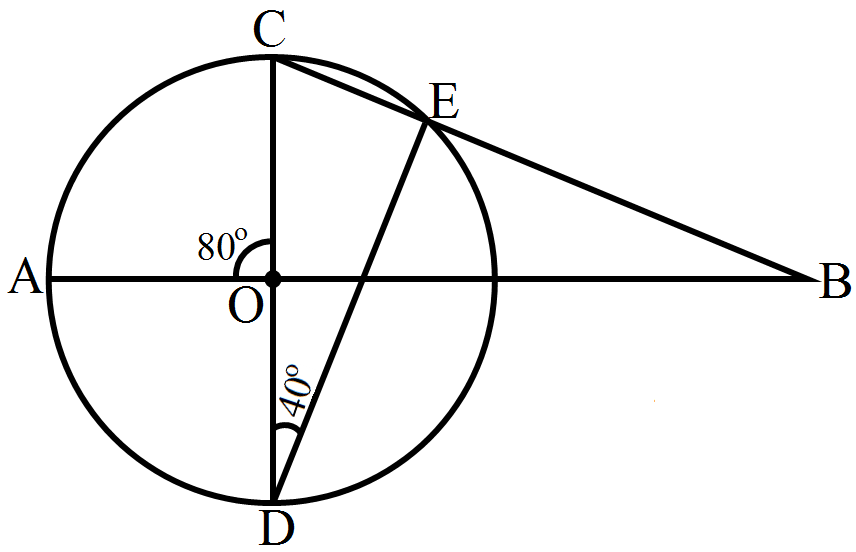
In the given figure, $AB$ and $CD$ are straight lines through the centre $O$ of a circle. If $\angle\text{AOC}=80^\circ$ and $\angle\text{CDE}=40^\circ,$ find
$i. \angle\text{DCE}$
$ii. \angle\text{ABC}$
Find the area of a trapezium whose parallel sides are $11\ m$ and $25\ m$ long, and the nonparallel sides are $15\ m$ and $13\ m$ long.
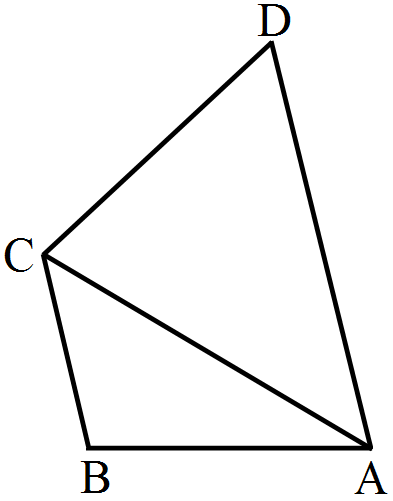
In the given figure, prove that
$i. CD + DA + AB > BC$
$ii. CD + DA + AB + BC > 2AC$.
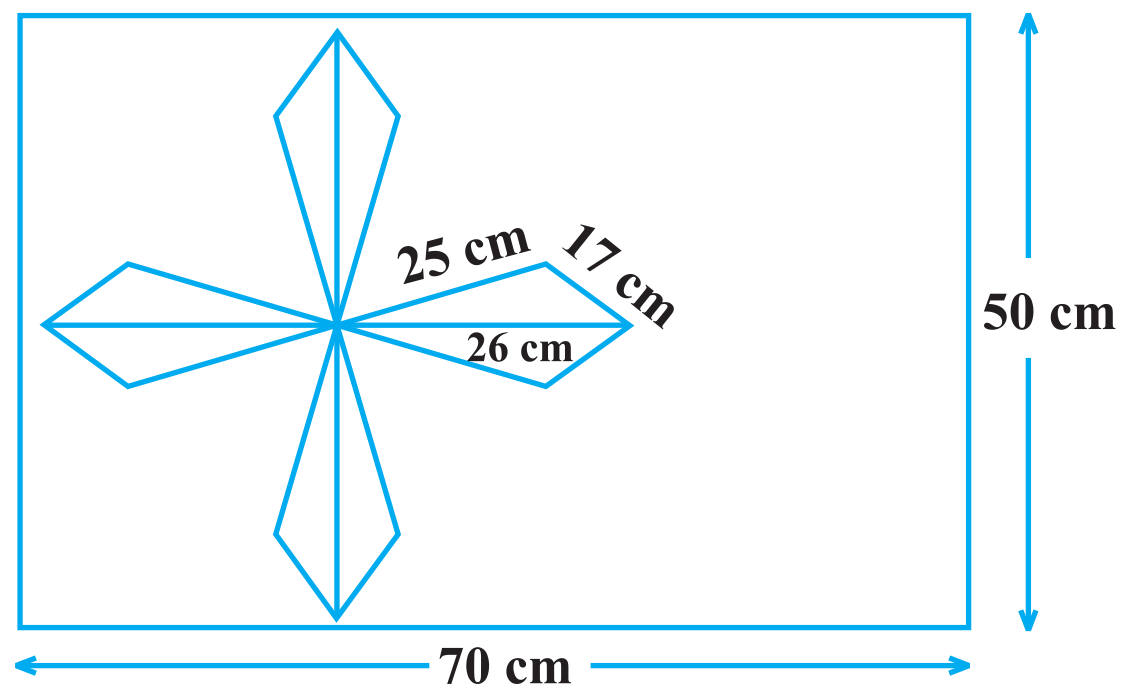
A design is made on a rectangular tile of dimensions $50cm \times 70cm$ as shown in the design shows $8$ triangles, each of sides $26\ cm, 17\ cm$ and $25\ cm$. Find the total area of the design and the remaining area of the tile.