MCQ
The position coordinates of a projectile projected from ground on a certain planet (with no atmosphere) are given by $y=\left(4 t-2 t^2\right) m$ and $x =(3 t)$ metre, where $t$ is in second and point of projection is taken as origin. The angle of projection of projectile with vertical is .........
  • A
    $30$
  • $37$
  • C
    $45$
  • D
    $60$

Answer

Correct option: B.
$37$
b
(b)

$y=4 t-2 t^2$

$x=3 t$

$V=V_{x \hat{i}}+V_{y \hat{j}}$

$V_x=\frac{d x}{d t}, V_y=\frac{d y}{d t}$

$V_x=3, V_y=4-4 t$

for $t=0, V_y=4$

$\tan \theta=\frac{V_y}{V_x}=\frac{4}{3}$

$\theta=53^{\circ}$ with horizontal

With vertical

$\theta=37^{\circ}$

Need a full question paper?

Generate a complete, print-ready paper with questions like this in minutes — across 16+ boards, with answer keys.

Start Generating Free

Similar questions

The centre of mass of an extended body on the surface of the earth and its centre of gravity.
An artillery piece of mass $M_1$ fires a shell of mass $\mathrm{M}_2$ horizontally. Instantaneously after the firing, the ratio of kinetic energy of the artillery and that of the shell is:
Which one of the following time-displacement graph represents two moving objects $P$ and $Q$ with zero relative velocity?
Water falls from a height of $60\,m$ at the rate of $15\,kg/s$ to operate a turbine. The losses due to frictional forces are $10\%$ of energy. How much power is generated by the turbine ....... $kW$ $(g = 10\,m/s^2)$
The spectrum from a black body radiation is a
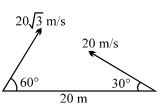
In the figure shown, the two projectiles are fired simultaneously. The minimum distance between them during their flight is  ........ $m$
Motion of a ball bearing inside a smooth curved bowl, when released from a point slightly above the lower point is:
  1. Simple harmonic motion.
  2. Non$-$periodic motion.
  3. Periodic motion.
  4. Periodic but not $\text{S.H.M}$
In an experiment to find surface tension of mercury with the help of capillary rise method the liquid column in capillary will 
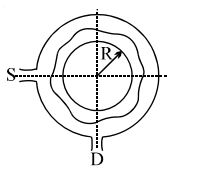
 A narrow tube is bent in the form of a circle of radius $R,$ as shown in the figure. Two small holes $S$ and $D$ are made in the tube at the positions right angle to each other. A source placed at $S$ generated a wave of intensity $I_0$ which is equally divided into two parts : One part travels along the longer path, while the other travels along the shorter path. Both the part waves meet at the point $D$ where a detector is placed If a maxima is formed at the detector then, the magnitude of wavelength $\lambda$ of the wave produced is given by $\pi R$
Three sound waves of equal amplitudes have frequencies $(n - 1 ), n, (n + 1 ).$ They superimpose to give beats. The number of beats produced per second will be