MCQ
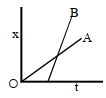
The position-time graphs for two students $A$ and $B$ returning from the school to their homes are shown in figure

$(A)$ $A$ lives closer to the school

$(B)$ $B$ lives closer to the school

$(C)$ $A$ takes lesser time to reach home

$(D)$ $A$ travels faster than $B$

$(E)$ $B$ travels faster than $A$

Choose the correct answer from the options given below :
  • $(A)$ and $(E)$ only
  • B
    $(B)$ and $(E)$ only
  • C
    $(A), (C)$ and $(E)$ only
  • D
    $(A), (C)$ and $(D)$ only

Answer

Correct option: A.
$(A)$ and $(E)$ only
a
As slope of $B$ > Slope of $A$

$\therefore V_B > V_A$

Also, $t _{ B } < t _{ A }$

Need a full question paper?

Generate a complete, print-ready paper with questions like this in minutes — across 16+ boards, with answer keys.

Start Generating Free

Similar questions

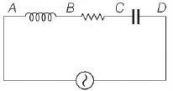
An $AC$ voltmeter connected between points $A$ and $B$ in the circuit below reads $36 \,V$. If it is connected between $A$ and $C$, the reading is $39 \,V$. The reading when it is connected between $B$ and $D$ is $25 \,V$. the voltmeter read when it is connected between $A$ and $D$ are ...........$V$ (Assume that, the voltmeter reads true rms voltage values and that the source generates a pure $AC$ )
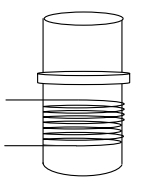
$STATEMENT-1$  A vertical iron rod has a coil of wire wound over it at the bottom end. An alternating current flows in the coil. The rod goes through a conducting ring as shown in the figure. The ring can float at a certain height above the coil. Because

$STATEMENT- 2$ In the above situation, a current is induced in the ring which interacts with the horizontal component of the magnetic field to produce an average force in the upward direction.

The initial activity of a certain radioactive isotope was measured as $16000\ counts\  min^{-1}$. Given that the only activity measured was due to this isotope and that its activity after $12\, h$ was $2000\ counts\ min^{-1}$, its half-life, in hours, is nearest to
A solid cylinder $(i)$ rolls down $(ii)$ slides down an inclined plane. The ratio of the accelerations in these conditions 
A wheel of mass $10\, kg$ has a moment of inertia of $160\, kg-m^2$ about its own axis, the radius of gyration will be ....... $m$
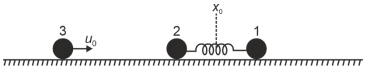
Two particles, $1$ and $2$ , each of mass $m$, are connected by a massless spring, and are on a horizontal frictionless plane, as shown in the figure. Initially, the two particles, with their center of mass at $x_0$, are oscillating with amplitude a and angular frequency $\omega$. Thus, their positions at time $t$ are given by $x_1(t)=\left(x_0+d\right)+a \sin \omega t$ and $x_2(t)=\left(x_0-d\right)-$ $a$ sin $\omega t$, respectively, where $d>2 a$. Particle $3$ of mass $m$ moves towards this system with speed $u_0=a \omega / 2$, and undergoes instantaneous elastic collision with particle 2 , at time $t_0$. Finally, particles $1$ and $2$ acquire a center of mass speed $v_{ cm }$ and oscillate with amplitude $b$ and the same angular frequency. . . . .

($1$) If the collision occurs at time $t_0=0$, the value of $v_{ cm } /(a \omega)$ will be

($2$) If the collision occurs at time $t_0=\pi /(2 \omega)$, then the value of $4 b^2 / a^2$ will be

Give the answer or quetion ($1$) and ($2$)

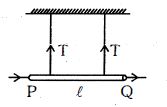
A conducting bar $PQ$ of length $l$ carrying current $I$ is suspended from a rigid support as shown in figure. A uniform magnetic field $B$ perpendicular to $PQ$ and directed away from the reader (inside the plane) is applied. If the mass of the bar is $M$ the tension in each string is
A proton sits at coordinates $(x, y) = (0, 0)$, and an electron at $(d, h)$, where $d >> h$. At time $t = 0$, $a$ uniform electric field $E$ of unknown magnitude but pointing in the positive $y$ direction is turned on. Assuming that $d$ is large enough that the proton-electron interaction is negligible, the $y$ coordinates of the two particles will be equal (at equal time)
Which of the following will not give the iodoform test
A combination of two thin lenses with focal lengths ${f_1}$ and ${f_2}$ respectively forms an image of distant object at distance $60 cm$ when lenses are in contact. The position of this image shifts by $30 cm$ towards the combination when two lenses are separated by $10 cm.$ The corresponding values of ${f_1}$ and ${f_2}$ are