MCQ
The positive value of $\lambda $ for which the co-efficient of $x^2$ in the expression ${x^2}{\left( {\sqrt x  + \frac{\lambda }{{{x^2}}}} \right)^{10}}$ is $720$ is
  • $4$
  • B
    $2\sqrt 2 $
  • C
    $\sqrt 5 $
  • D
    $3$

Answer

Correct option: A.
$4$
a
$x^{2}\left(\sqrt{x}+\frac{\lambda}{x^{2}}\right)^{10}$

Consider constant term

$^{10} \mathrm{C}_{\mathrm{r}}(\sqrt{\mathrm{x}})^{10-\mathrm{r}}\left(\frac{\lambda}{\mathrm{x}^{2}}\right)^{r}$

$\frac{10-r}{2}-2 r=0$

$10-5 r=0$

$r=2$

$\Rightarrow^{10} \mathrm{C}_{2} \times \lambda^{2}=720$

$ \Rightarrow \lambda=4$

Need a full question paper?

Generate a complete, print-ready paper with questions like this in minutes — across 16+ boards, with answer keys.
Start Generating Free

Similar questions

A box contains $15$ tickets numbered $1, 2, ....... 15$. Seven tickets are drawn at random one after the other with replacement. The probability that the greatest number on a drawn ticket is $9$, is
The lines $2x−3y=5$ and $3x−4y=7$ are the diameters of a circle of area $154$ sq.units. The equation of the circle is:
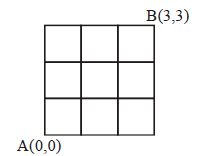
Total number of possible ways in which a person can go from $A$ to $B$ if he can travel only to the right or upward along the lines, is equal to
There are $9$ chairs in a room on which $6$ persons are to be seated, out of which one is guest with one specific chair. In how many ways they can sit
If $a > 0$ , $b < 0$ , then $\mathop {\lim }\limits_{x \to {0^ + }} \frac{{\sqrt {\left( {1 - \cos 2ax} \right)} }}{{\sin \,bx}}$ is equal to 
$A = (2, 4, 5)$ and $B = (3, 5, -4)$ are two points. lf the $XY-$plane, $YZ-$plane divide $AB$ in the ratio $a : b$ and $p : q$ respectively, then $\frac{\text{a}}{\text{b}}+\frac{\text{p}}{\text{q}}=$
The sum of all three digit numbers, formed using non zero digits, with all the digits perfect  square of a natural number, is
Equation of the hyperbola whose vertices are $(\pm3,0)$ and foci at $(\pm5,0),$ is
Coefficient of $x^3$ in the expansion of $(x^2 - x + 1)^{10} (x^2 + 1 )^{15}$ is equal to
A line through $A( - 5, - \;4)$ meets the lines $x + 3y + 2 = 0,$ $2x + y + 4 = 0$ and $x - y - 5 = 0$ at $B, \,C$ and $D$ respectively. If ${\left( {\frac{{15}}{{AB}}} \right)^2} + {\left( {\frac{{10}}{{AC}}} \right)^2} = {\left( {\frac{6}{{AD}}} \right)^2},$ then the equation of the line is