MCQ
The potassium ferrocyanide solution gives Prussian blue colour, when added to :
  • A
    $\mathrm{CoCl}_{3}$
  • B
    $\mathrm{FeCl}_{2}$
  • C
    $\mathrm{CoCl}_{2}$
  • $\mathrm{FeCl}_{3}$

Answer

Correct option: D.
$\mathrm{FeCl}_{3}$
d
$\left.\mathrm{FeCl}_{3}+\mathrm{K}_{4}\left[\mathrm{Fe}(\mathrm{CN})_{6}\right] \rightarrow \mathrm{Fe}_{4}[\mathrm{Fe}(\mathrm{CN})]_{6}\right]_{3}$

$\quad\quad\quad\quad\quad\quad\quad\quad\quad\quad\quad$Prussian blue

Need a full question paper?

Generate a complete, print-ready paper with questions like this in minutes — across 16+ boards, with answer keys.

Start Generating Free

Similar questions

For a first order reaction $(A)\rightarrow$ products the concentration of $A$ changes from $0.1\, M $ to $0.025\,M\,40\,\min$.

The rate of reaction when the concentration of $A$ is $0.01\, M$ is ............$\times 10^{-4}\,M/ \min$

The fundamental basis of the present-day Periodic Table is that elements are
Major product of the given reaction is
In the following :

$\begin{gathered}
  {\left[ {Al{{\left( {{H_2}O} \right)}_6}} \right]^{ + 3}} + HCO_3^ -  \rightleftarrows {\left[ {Al{{\left( {{H_2}O} \right)}_5}OH} \right]^{ + 2}} + {H_2}C{O_3} \hfill \\
  \,\,\,\,\,\,\,\,\,\,\,\,(A)\,\,\,\,\,\,\,\,\,\,\,\,\,\,\,\,\,\,\,\,(B)\,\,\,\,\,\,\,\,\,\,\,\,\,\,\,\,\,\,\,\,\,\,\,\,\,\,\,\,\,\,\,\,\,\,\,\,\,(C)\,\,\,\,\,\,\,\,\,\,\,\,\,\,\,\,\,\,\,\,\,\,\,(D) \hfill \\ 
\end{gathered} $

species behaving as bronsted -lowry acid are

Copper reduces $NO _{3}^{-}$ into $NO$ and $NO _{2}$ depending uponthe concentration of $HNO _{3}$ insolution. (Assuming fixed $\left[ Cu ^{2+}\right]$ and $\left. P _{ NO }= P _{ NO _{2}}\right),$ the $HNO _{3}$ concentration at which the thermodynamic tendency for reduction of $NO _{3}^{-}$ into $NO$ and $NO _{2}$ by copper is same is $10^{ x }\, M$. The value of $2 x$ is ...... .

$\left[\right.$ Given $, E_{C u^{2+} / C u}^{o}=0.34\, V , E _{ NO _{3}^{-} / NO_2 }^{\circ}=0.96\, V$ (Rounded-off to the nearest integer) $E _{ NO _{3} / NO _{2}}^{\circ}=0.79 \,V$ and at $298 \,K$  $\left.\frac{ RT }{ F }(2.303)=0.059\right]$

${H_3}P{O_3}$ gets hydrolysed giving .......
Which of the following has $s{p^3}$ hybridisation
Resistance of $0.2\, M$ solution of an electrolyte is $50 \Omega .$The specific conductance of the solution is $1.4\, S\, m^{-1}.$ The resistance of $0.5\, M$ solution of the same electrolyte is $280\, \Omega .$ The molar conductivity of $0.5\, M$ solution of the electrolyte in $S\, m^2\, mol^{-1}$ is :
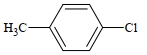
The $IUPAC$ name(s) of the following compound is(are)

$[A]$ $4$-methylchlorobenzene   $[B]$ $4$-chlorotoluene   $[C]$ $1$-chloro-$4$-methylbenzene    $[D]$ $1$-methyl-$4$-chlorobenzene
Which of the following acids is isomeric with phthalic acid