Question
The potential barrier, in the depletion layer, is due to

Answer

(a) The depletion layer is the region at the junction of a diode which is devoid of ions. Therefore the potential barrier in the depletion layer is due to ions.

Need a full question paper?

Generate a complete, print-ready paper with questions like this in minutes — across 16+ boards, with answer keys.
Start Generating Free

Similar questions

A printed page is pressed by a glass of water. The refractive index of the glass and water is $1.5$ and $1.33$, respectively. If the thickness of the bottom of glass is $1\, cm$ and depth of water is $5\, cm$ , how much the page will appear to be shifted if viewed from the top ?
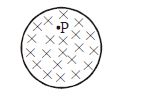
Figure shows a uniform magnetic field $B$ confined to a cylindrical volume and increasing at a constant rate. The instantaneous acceleration experienced by an electron placed at $P$ is
A solid cylinder of density $\rho_0$, cross-section area $A$ and length $l$ floats in a liquid of density $\rho\left( >\rho_0\right)$ with its axis vertical, as shown. If it is slightly displaced downward and released, the time period will be .......
Fusion reaction is initiated with the help of
The ionisation potential of hydrogen atom is $13.6$ volt. The energy required to remove an electron from the second orbit of hydrogen is......$eV$
The change in potential energy, when a body of mass $m$ is raised to a height $nR$ from the earth's surface is ($R =$ Radius of earth)
A potentiometer consists of a wire of length $4\, m$ and resistance $10\,\Omega $. It is connected to a cell of $e.m.f.$ $2\, V$. The potential difference per unit length of the wire will be ............. $V/m$
A rigid body can be hinged about any point on the $x$ -axis. When it is hinged such that the hinge is at $x$, the moment of inertia is given by $I = 2x^2 - 12x + 27$ The $x$ -coordinate of centre of mass is
A liquid flows through a horizontal tube. The velocities of the liquid in the two sections, which have areas of cross-section ${A_1}$ and ${A_2}$, are ${v_1}$ and ${v_2}$ respectively. The difference in the levels of the liquid in the two vertical tubes is $ h$
A block of mass $10\; \mathrm{kg}$ is in contact against the inner wall of a hollow cylindow cylindrical drum of radius $1 \;\mathrm{m}$. The coeffident of friction between the block and the inner wall of the cylinder is $0.1$. The minimum angular velocity needed for the cylinder to keep the block stationary when the cylinder is vertical and rotating about its axis, will be: ......$rad/s$ $\left(g-10 m / s^{2}\right)$