MCQ
The potential barrier, in the depletion layer, is due to
  • Ions
  • B
    Holes
  • C
    Electrons
  • D
    Both $(b)$ and $ (c)$ 

Answer

Correct option: A.
Ions
a
(a) The depletion layer is the region at the junction of a diode which is devoid of ions. Therefore the potential barrier in the depletion layer is due to ions.

Need a full question paper?

Generate a complete, print-ready paper with questions like this in minutes — across 16+ boards, with answer keys.

Start Generating Free

Similar questions

A graph of the square of the velocity against the square of the acceleration of a given simple harmonic motion is
The spectral energy distribution of star is maximum at twice temperature as that of sun. The total energy radiated by star is
A simple harmonic motion having an amplitude $A$ and time period $T$ is represented by the equation : $y = 5 \sin \pi (t + 4) m$

Then the values of $A$ (in $m$) and $T$ (in $sec$) are :
The temperature of an ideal gas is reduced from  $927^\circ C$ to  $27^\circ C$. The $r.m.s.$ velocity of the molecules becomes
Two tuning forks have frequencies $450\, Hz$ and $454\, Hz$ respectively. On sounding these forks together, the time interval between successive maximum intensities will be .... $sec$
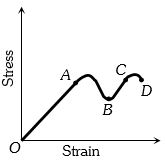
In the below graph, point $D$ indicates
Match the corresponding entries of column $I$  with column $II$. [Where $m$ is the magnification produced by the mirror]

 $\begin{array}{|l|l|} \hline Column\,\,-I  & Column\,\,-\,\,II\,\, \\ \hline 1.\,\,m=-2  & a.\,\,Convex\,\,mirror \\ \hline 2.\,\,m=\,\,\frac{-1}{2} & b.\,\,Concave\,\,mirror \\ \hline 3.\,\,m=+2  & c.\,\,Real\,\,Image \\ \hline 4.\,\,m=\,\,\frac{+1}{2} & d.\,\,Virtual\,\,image \\ \hline \end{array}$
Sixty-four drops are jointed together to form a bigger drop. If each small drop has a capacitance $C$, a potential $V$, and a charge $q$, then the capacitance of the bigger drop will be
In a $L-C-R$ circuit, capacitance is changed from $C$ to $2C$ . For the resonant frequency to remain unchanged, the inductance should be change from $L$ to
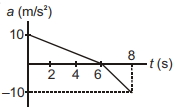
The acceleration-time graph for a particle moving along $x$-axis is shown in figure. If the initial velocity of particle is $-5 \,m / s$, the velocity at $t=8 \,s$ is ....... $m / s$