The potential difference across a resistor $‘r\ ’$ carrying current $‘I\ ’$ is $Ir.$
  1. Now if the potential difference across $‘r\ ’$ is measured using a voltmeter of resistance $‘RV\ ’,$ show that the reading of voltmeter is less than the true value
  2. Find the percentage error in measuring the potential difference by a voltmeter.
  3. At what value of $RV,$ does the voltmeter measures the true potential difference?
Download our app for free and get startedPlay store
  1. $V = lr ($without voltmeter $R_V)$
  1. $\Big(\frac{\text{V}-\text{V}'}{\text{V}}\Big)\times100=\Big(\frac{\text{r}}{\text{r}+\text{R}_\text{V}}\Big)\times100$
  2. $\text{R}_\text{V}\xrightarrow{\ \ \ \ \ \ }\infty,\text{V}'=\text{lr}=\text{V}$
  3. $\text{V}'=\frac{\text{lrR}_\text{V}}{\text{r}+\text{R}_\text{V}}=\frac{\text{Ir}}{1+\frac{\text{r}}{\text{R}_\text{V}}}$
    $\text{V}'<\text{V}$
  4. Percentage error,
art

Download our app
and get started for free

Experience the future of education. Simply download our apps or reach out to us for more information. Let's shape the future of learning together!No signup needed.*

Similar Questions

  • 1
    The specification on a heater coil is 250V, 500W. Calculate the resistance of the coil. What will be the resistance of a coil of 1000W to operate at the same voltage?
    View Solution
  • 2
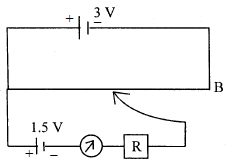
    Two primary cells of emfs wire $\varepsilon_1$ and $\varepsilon_2(\varepsilon_1>\varepsilon_2)$ are connected to a potentiometer wire AB as shown in fig. If the balancing lengths for the two combinations of the cells are 250cm and 400cm, find the ratio of $\varepsilon_1$ and $\varepsilon_2.$
    View Solution
  • 3
    A potentiometer wire of length 1.0 m has a resistance of l5 $\Omega$. It is connected to a 5 V battery in series with a resistance of 5 $\Omega$ Determine the emf of the primary cell which gives a balance point at 60 cm.
    View Solution
  • 4
    For the potentiometer circuit shown in the given figure, points X and Y reprensent the two terminals of an unknown emf E'. A student observed that when the jockey in moved from the end A to the end B of the potentiometer wire, the deflection in the galvanometer remains in the same direction.What may be the two possible faults in the circuit that could result in this obsevation?
    If the galvanometer deflection at the end B is (i) more, (ii) less, than that at the end A, which of the two faults, listed above, would be there in the circuit?
    Give reasons in support of your answer in each case.
    View Solution
  • 5
    Is the motion of a charge across junction momentum conserving? Why or why not?
    View Solution
  • 6
    The four arms of a Wheatstone bridge $($Fig. $3.19)$ have the following resistances:
    $AB =100 \Omega, BC =10 \Omega, CD =5 \Omega \text {, and } DA =60 \Omega \text {. }$
    Image
    A galvanometer of $15 \Omega$ resistance is connected across $BD$. Calculate the current through the galvanometer when a potential difference of $10 V$ is maintained across $AC$.
    View Solution
  • 7
    State Kirchhoff's rules of current distribution in an electrical network. Using these rules determine the value of the current I1 in the electric circuit given below.
    View Solution
  • 8
    A capacitor of capacitance $10\mu\text{F}$ is connected across a battery of emf 6.0V through a resistance of $20\text{k}\Omega$ for 4.0s. The battery is then replaced by a thick wire. What will be the charge on the capacitor 4.0s after the battery is disconnected?
    View Solution
  • 9
    Write the principle of working of a potentiometer. Describe briefly, with the help of a circuit diagram, how a potentiometer is used to determine the internal resistance of a given cell.
    View Solution
  • 10
    Two heating elements of resistances $R_{1}$ and $R_{2}$ when operated at a constant supply of voltage, $V$, Consume power $P_1$ and $P_2$ respectively. Deduce the expressions for the power of their combination when they are, in turn, connected in $(i)$ series and $(ii)$ parallel across the same voltage supply.
    View Solution