MCQ
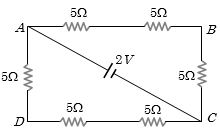
The potential difference between points $A$ and $B$ of adjoining figure is
  • A
    $\frac{2}{3}\,V$
  • B
    $\frac{8}{9}\,V$
  • $\frac{4}{3}\,V$
  • D
    $2\,V$

Answer

Correct option: C.
$\frac{4}{3}\,V$
c
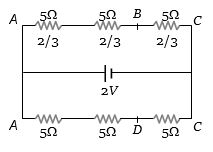
The given circuit can be redrawn as follows

For identical resistances, potential difference distributes equally among all. Hence potential difference across each resistance is $\frac{2}{3}\,V,$ and potential difference between $A$ and $B$ is $\frac{4}{3}\,V.$
Need a full question paper?

Generate a complete, print-ready paper with questions like this in minutes — across 16+ boards, with answer keys.
Start Generating Free

Similar questions

A Carnot engine works between $27^{\circ} C$ and $127^{\circ} C$. Heat supplied by the source is $500\, J$. then heat ejected to the sink is (in $J$)
A hollow spherical shell is compressed to half its radius. The gravitational potential at the centre
The meniscus of a liquid contained in one of the limbs of a $U-$ tube is placed between the poles of an electromagnet with the meniscus in line with the field. The liquid is seen to rise in the limb by small amount. This indicates that the liquid is 
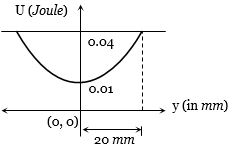
The variation of potential energy of harmonic oscillator is as shown in figure. The spring constant is
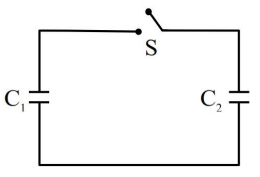
A capacitor, $C _1=6 F$ is charged to a potential difference of $V _0=5 V$ using a 5 V battery. The battery is removed and another capacitor, $C _2=12$ $\mu F$ is inserted in place of the battery. When the switch ' S ' is closed, the charge flows between the capacitors for some time until equilibrium condition is reached. What are the charges $\left(q_1\right.$ and $q_2$ ) on the capacitors $C _1$ and $C _2$ when equilibrium condition is reached.
Image
The variation of momentum with time of one of the body in a two body collision is shown in fig. The instantaneous force is maximum corresponding to point
Liquid cools from $50^oC$  to  $45^oC$  in  $5\  minutes$ and from $45^oC$ to $41.5^oC$ in the next $5\   minutes$.The temperature of the surrounding is ......... $^oC$
Beats are produced by two waves ${y_1} = a\sin 1000\,\pi t,$ ${y_2} = a\sin 998\pi t$The number of beats heard/sec is
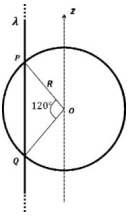
An infinitely long thin non-conducting wire is parallel to the $z$-axis and carries a uniform line charge density $\lambda$. It pierces a thin non-conducting spherical shell of radius $R$ in such a way that the arc $PQ$ subtends an angle $120^{\circ}$ at the centre $O$ of the spherical shell, as shown in the figure. The permittivity of free space is $\epsilon_0$. Which of the following statements is (are) true?

$(A)$ The electric flux through the shell is $\sqrt{3} R \lambda / \epsilon_0$

$(B)$ The z-component of the electric field is zero at all the points on the surface of the shell

$(C)$ The electric flux through the shell is $\sqrt{2} R \lambda / \epsilon_0$

$(D)$ The electric field is normal to the surface of the shell at all points
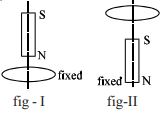
A vertical bar magnet is dropped from position on the axis ofafixed metallic coil as shown in fig $- I$. In fig $- II$ the magnet is fixed and horizontal coil is dropped. The acceleration of the magnet and coil are $a_1$ and $a_2$ respectively then