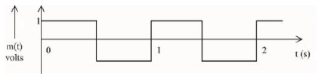
b
Displacement current is given by
$\mathrm{i}_{\mathrm{d}}=\varepsilon_{0} \frac{\partial \phi_{\mathrm{E}}}{\partial \mathrm{t}}$
where $\phi_{\mathrm{E}}$ is the electric flux given as $\phi_{\mathrm{E}}=\mathrm{EA}$ where $A$ is area of the capacitor plates and $E$ is the electric field between the plates.
So, $\mathrm{i}_{\mathrm{d}}=\varepsilon_{0} \frac{\partial(\mathrm{EA})}{\partial \mathrm{t}}=\varepsilon_{0} \mathrm{A} \frac{\partial \mathrm{E}}{\partial \mathrm{t}}$
But $\mathrm{E}=\mathrm{V} / \mathrm{d}$ where $\mathrm{V}$ is the potential difference between the capacitor plates separated at $d$ distant apart.
So, $i_{d}=\frac{\varepsilon_{0} A}{d} \frac{\partial V}{\partial t}=C \frac{\partial V}{\partial t}$
where $\mathrm{C}$ is the capacity of the capacitor.
$\therefore $ $\mathrm{i}_{\mathrm{d}}=2 \times 10^{-6} \times 10^{6}=2 \mathrm{A}$