MCQ
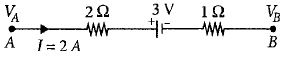
The potential difference $(V_A - V_B)$ between the points $A$ and $B$ in the given figure is ............ $V$
  • A
    $+6$
  • $+9$
  • C
    $-3$
  • D
    $+3$

Answer

Correct option: B.
$+9$
b
$V_{A B}=V_{A}-V_{B}=2 \times 2+3+1 \times 2=9\, \mathrm{V}$

Need a full question paper?

Generate a complete, print-ready paper with questions like this in minutes — across 16+ boards, with answer keys.
Start Generating Free

Similar questions

A uniform heavy rod of weight $10\, {kg} {ms}^{-2}$, crosssectional area $100\, {cm}^{2}$ and length $20\, {cm}$ is hanging from a fixed support. Young modulus of the material of the rod is $2 \times 10^{11} \,{Nm}^{-2}$. Neglecting the lateral contraction, find the elongation of rod due to its own weight. (In $\times 10^{-10} {m}$)
If work $W$ is done in blowing a bubble of radius $R$ from a soap solution, then the work done in blowing a bubble of radius $2R$ from the same solution is
Which of the following is $NOT$ true for electromagnetic waves ?
According to $C.E.$ van der Waal, the interatomic potential varies with the average interatomic distance $(R)$ as
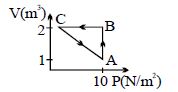
An ideal gas is taken through the cycle $A \to B \to C \to A$ , as shown in the figure. If the net heat supplied to the gas in the cycle is $5\ J$, the work done by the gas in the process $C \to A$ is  .... $J$
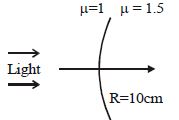
What is the focal length of this curved surface ?........$cm$
Force $F$ is given in terms of time $t$ and distance $x$ by $F = a\, sin\, ct + b\, cos\, dx$, then the dimension of $a/b$ is
The objective glass of a telescope is an achromat of focal length $90\,cm$ . The magnitude of dispersive power of the two lenses are $0.024$ and $0.036$ . The focal lengths are 
A round uniform body of radius $R$, mass Mand moment of inertia $I$ rolls down (without slipping) an inclined plane making an angle $\theta$ with the horizontal. Then its acceleration is
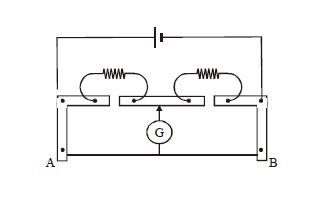
A meter bridge set up as shown to determine end correction at $A$ and $B$. When a resistance of $15\ \Omega$ is used in left gap and of $20\ \Omega$ in right gap, then null point comes at a distance $42\ cm$ from $A$. When these resistances are interchanged null point comes at a distance $57\ cm$ from $A$. Values of end corrections are