MCQ
The potential differences across the resistance, capacitance and inductance are $80\,\, V, \,\,40 \,\,V$ and $100\,\, V$ respectively in an $L-C-R$ circuit. The power factor of this circuit is 
  • $0.8$
  • B
    $1$
  • C
    $0.4$
  • D
    $0.5$

Answer

Correct option: A.
$0.8$
a
$\text { Here, } V_{R}=80\, \mathrm{V}, V_{c}=40\, \mathrm{V}, V_{L}=100 \,\mathrm{V}$

Power factor, $\cos \phi=\frac{R}{Z}$

${=\frac{V_{R}}{V}=\frac{V_{R}}{\sqrt{V_{R}^{2}+\left(V_{L}-V_{C}\right)^{2}}}}$

${=\frac{80}{\sqrt{(80)^{2}+(100-40)^{2}}}=\frac{80}{100}=0.8}$

Need a full question paper?

Generate a complete, print-ready paper with questions like this in minutes — across 16+ boards, with answer keys.
Start Generating Free

Similar questions

A balloon and its content having mass $M$ is moving up with an acceleration 'a'. The mass that must be released from the content so that the balloon starts moving up with an acceleration ' $3 \mathrm{a}^{\prime}$ will be : (Take ' g ' as acceleration due to gravity)
The correct curve between the height or depression $h$ of liquid in a capillary tube and its radius is
$A$ screen is placed $90\, cm$ from a object. The image of an object on the screen is formed by a convex lens at two different locations separated by $20\, cm$.  if the size of the image formed at the positions are $6 \,cm$ and $3\, cm$, then the highest of the object is.....$cm$
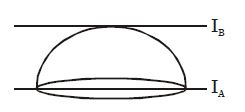
Moment of inertia of a uniform hollow hemi-sphere about given axis is $I_A$ and $I_B$ then
A ray of light is incident at $50°$ on the middle of one of the two mirrors arranged at an angle of $60°$ between them. The ray then touches the second mirror, get reflected back to the first mirror, making an angle of incidence of.........$^o$
A sample of gas with $\gamma=1.5$ is taken through an adiabatic process in which the volume is compressed from $1200\, {cm}^{3}$ to $300\, {cm}^{3}$. If the initial pressure is $200\, {kPa}$. The absolute value of the workdone by the gas in the process $= \,..... J.$
A calcite crystal is placed over a dot on a piece of paper and rotated, on seeing through the calcite one will be see
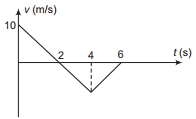
For the velocity-time graph shown in the figure, in a time interval from $t=0$ to $t=6\,s$, match the following columns.
Colum $I$ Colum $II$
$(A)$ Change in velocity $(p)$ $-5 / 3\,Sl$ unit
$(B)$ Average acceleration $(q)$ $-20\,SI$ unit
$(C)$ Total displacement $(r)$ $-10\,SI$ unit
$(D)$ Acceleration at $t=3\,s$ $(s)$ $-5\,SI$ unit

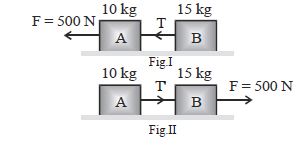
Two bodies $A$ and $B$ of masses $10\,\, kg$ and $15\, kg$ respectively kept on a smooth, horizontal surface are tied to the ends of a light string. If $T$ represents the tension in the string when a horizontal force $F = 500\, N$ is applied to $A$ (as shown in figure $1$) and $T'$ be the tension when it is applied to $B$ (figure $2$), then which of the following is true
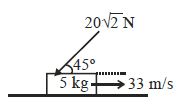
A block of mass $5\, kg$ is kept on a rough horizontal floor. It is given a velocity $33\, m/s$ towards right. A force of $20\sqrt {2\,} \,N$ continuously acts on the block as shown in the figure. If the coefficient of friction between block and floor is $0.5$ the velocity of block after $3\, seconds$ is ........ $m/s$  ($g = 10\, m/s^2$)