MCQ
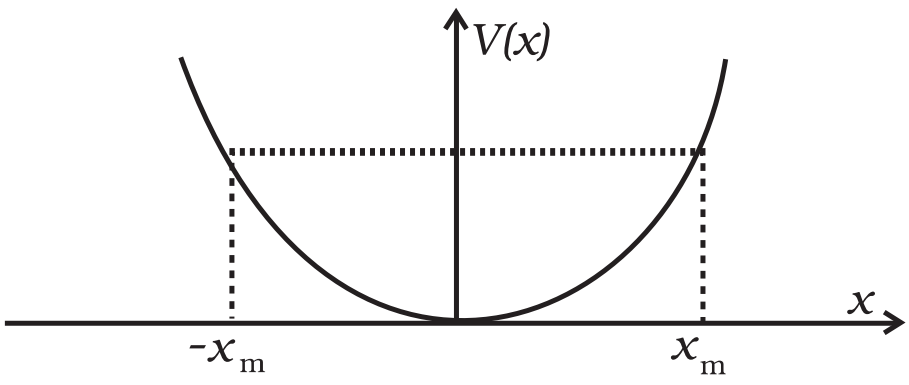
The potential energy function for a particle executing linear SHM is given by $\text{v(x)}=\frac{1}{2}\text{kx}^2$ where k is the force constant of the oscillator. For k = 0.5N/ m, the graph of V(x) versus x is shown in the figure. A particle of total energy E turns back when it reaches $\text{x}=\pm\text{x}_\text{m}.$ If V and K indicate the P.E. and K.E., respectively of the particle at x = +xm, then which of the following is correct?
  • A
    V = 0, K = E
  • B
    V = E, K = 0
  • C
    V < E, K = 0
  • D
    V = 0, K < E

Answer

  1. V = E, K = 0

Explanation:

Key concept: Energy Graph for a Spring: If the mass attached with spring performs simple harmonic motion about its mean position then its potential energy at any position (x) can be given by,
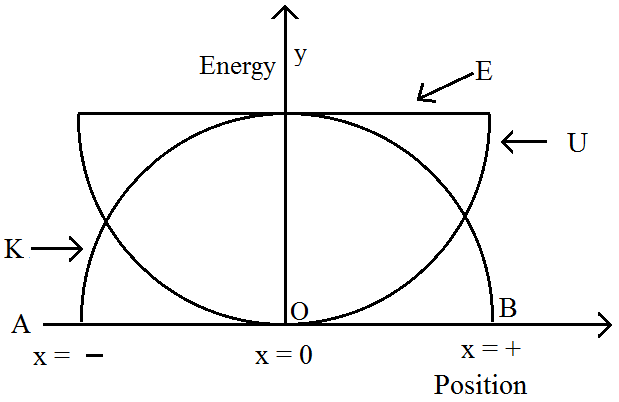
Now kinetic energy at any position $\text{K}=\text{E}-\text{U}=\frac{1}{2}\text{Ka}^2-\frac{1}{2}\text{Kx}^2$

$\text{K}=\frac{1}{2}(\text{a}^2-\text{x}^2)\ ....(\text{i})$

From the above formula, we can cheak that

$\text{U}_\text{max}=\frac{1}{2}\text{Ka}^2$ $\big[\text{At extreme x}=\pm\text{a}\big]$ and Umin = 0 [At mean x = 0]

$\text{K}_\text{max}=\frac{1}{2}\text{Ka}^2$ [At mean x = 0] and Kmin = 0 $\big[\text{At extreme x}=\pm\text{a}\big]$

$\text{E}=\frac{1}{2}​​\text{ka}^2=​​\text{constant(at all positions)}$

Because velocity of mass = 0 [at extreme position]

$\therefore\ \text{K}=\frac{1}{2}\text{mv}^2=0$

It means kinetic energy changes parabolically w.r.t. position but total energy remain always constant irrespective to the position of mass.

Total energy is E = PE + KE, which remains constant.

According to the question, when paraticle is at x = xm, i.e., at extreme position x = xm ⇒ KE = 0

Hence, total energy will be

$\text{E}=\text{PE}+0=\text{PE}$

$\Rightarrow\text{V}\text{(x}_\text{m})=\frac{1}{2}\text{kx}^2_\text{m}$

Hence option (b) is correct.

V = E, K = 0
Need a full question paper?

Generate a complete, print-ready paper with questions like this in minutes — across 16+ boards, with answer keys.

Start Generating Free

Similar questions

The magnitude of potential energy per unit mass of an object at the surface of earth is $E$, then the escape velocity of the object is ..........
Displacement x , of a body moving in one-dimensional motion depends on time $t$ as follows : $x=a_0+a_1 t+a_2 t^2+a_3 t^3$ where $a_0, a_1, a_2, a_3$ are fixed.
Then the correct statement is :
A simple pendulum is placed at a place where its distance from the earth's surface is equal to the radius of the earth. If the length of the string is $4 \mathrm{~m}$, then the time period of small oscillations will be ____ $s$. $\left[\right.$ take $\left.\mathrm{g}=\pi^2 \mathrm{~ms}^{-2}\right]$
Force constant of a spring is $K$ . If half part is detached then force constant of the remaining spring will be
During which of the following thermodynamic process represented by $P V$ diagram the heat energy absorbed by system may be equal to area under $P V$ graph?
The ratio of the speed of sound in nitrogen gas to that in helium gas, at $300 K$ is
The potential energy of a molecule on the surface of a liquid compared to one inside the liquid is
A particle initially at rest is subjected to two forces. One is constant, the other is a retarding force proportional to the particle velocity. In the subsequent motion of the particle :
A circular disc X of radius R is made from an iron plate of thickness t, and another plate Y of radius 4R is made from an iron plate of thickness $\frac{\text{t}}{4}$ The ratio between moment of inertia $\frac{\text{I}_{\text{y}}}{\text{I}_{\text{x}}}$ is:
A man of mass $40\, kg$ is standing on a trolley $A$ of mass $140 \,kg$ . He pushes another trolley $B$ of same material of mass $60\, kg$, so that they are set in motion . Then :