MCQ
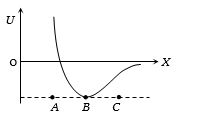
The potential energy $U$ between two molecules as a function of the distance $X$ between them has been shown in the figure. The two molecules are
  • A
    Attracted when $x$ lies between $A$ and $B$ and are repelled when $X$ lies between $B$ and $C$
  • Attracted when $x$ lies between $B$ and $C$ and are repelled when $X$ lies between $A$ and $B$
  • C
    Attracted when they reach $B$
  • D
    Repelled when they reach $B$

Answer

Correct option: B.
Attracted when $x$ lies between $B$ and $C$ and are repelled when $X$ lies between $A$ and $B$
b
(b) $F = - \left( {\frac{{dU}}{{dx}}} \right)$. 

In the region $BC$ slope of the graph is positive 

$F =$ negative i.e. force is attractive in nature 

In the region $AB$ slope of the graph is negative 

$ F =$ positive i.e. force is repulsive in nature

Need a full question paper?

Generate a complete, print-ready paper with questions like this in minutes — across 16+ boards, with answer keys.

Start Generating Free

Similar questions

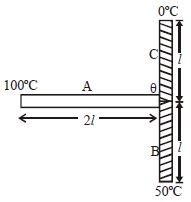
Three rods $A, B$ and $C$ of thermal conductivities $K, 2\,K$ and $4\,K$, cross-sectional  areas $A, 2\,A$ and $2\,A$ and lengths $2l, l$ and $l$ respectively are connected as shown  in the figure. If the ends of the rods are maintained at temperatures $100^o\,C, 50^o\,C$, and $0^o\,C$ respectively, then the temperature $\theta$ of the junction is ......... $^oC$
A source and an observer move away from each other with a velocity of $10\; m/s$ with respect to ground. If the observer finds the frequency of sound coming from the source as $1950 \;Hz$, then actual frequency of the source is .... $Hz$ (velocity of sound in air = $340\; m/s$)
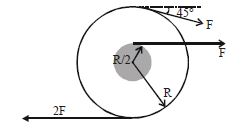
A wheel of radius $R$ with an axle of radius $R/2$ is shown in the figure and is free to rotate about a frictionless axis through its centre and perpendicular to the page. Three forces $(F, F, 2F)$ are exerted tangentially to the respective rims as shown in the figure. The magnitude of the net torque acting on the system is nearly 
Two perfectly identical wires are in unison. When the tension in one wire is increased by $1\%$, then on sounding them together $3$ beats are heard in $2 \,sec$. The initial frequency of each wire is .... ${\sec ^{ - 1}}$
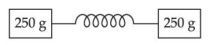
As per the given figure, two blocks each of mass $250\,g$ are connected to a spring of spring constant $2\,Nm ^{-1}$. If both are given velocity $V$ in opposite directions, then maximum elongation of the spring is:
If net force on a system is zero then
The dimensional formula for Planck's constant $(h)$ is
Starting from the origin at time $t=0,$ with initial velocity $5 \hat{ j }\, ms ^{-1},$ a particle moves in the $x-y$ plane with a constant acceleration of $(10 \hat{ i }+4 \hat{ j })\, ms ^{-2}$. At time $t$, its coordinates are $\left(20\, m , y _{0}\, m \right) .$ The values of $t$ and $y _{0},$ are respectively
The angular speed of a fly-wheel making $120\, revolution/minute$ is
For an ideal gas the instantaneous change in pressure $'{p} '$ with volume $'v'$ is given by the equation $\frac{{dp}}{{dv}}=-{ap} .$ If ${p}={p}_{0}$ at ${v}=0$ is the given boundary condition, then the maximum temperature one mole of gas can attain is :

(Here ${R}$ is the gas constant)