MCQ
The present atomic weight scale is based on
  • ${C^{12}}$
  • B
    ${O^{16}}$
  • C
    ${H^1}$
  • D
    ${C^{13}}$

Answer

Correct option: A.
${C^{12}}$
a
The atomic mass refers to the actual physical mass of an atom.

The atomic mass is very small in the numerical values that's why it is calculated on the basis of comparison with the mass of carbon-$12$ isotope.

Need a full question paper?

Generate a complete, print-ready paper with questions like this in minutes — across 16+ boards, with answer keys.
Start Generating Free

Similar questions

Which is not paramagnetic
In the following sequence of reactions $C{H_3}C{H_2}OH\,\xrightarrow{{P + {I_2}}}A\xrightarrow[{Ether}]{{Mg}}B\xrightarrow{{HCHO}}C\xrightarrow{{{H_2}O}}D,$ then compound $'D'$ is
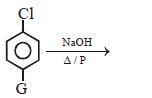
Rate of reaction is maximum if $G$ is
For a liquid normal boiling point is $-173\,^oC$ then at $2\  atm$ pressure it's boiling point should be nearly ......... $^oC.$ $(\Delta H_{vap} = 200\ cal/mole,\  R = 2 \ cal/mol-K,\,\,\ln \,2 = 0.7)$
The osmotic pressures of $0.010\,\,M$  solutions of  $KI$  and of sucrose $(C_{12}H_{22}O_{11})$  are $0.432\,\,atm$  and  $0.24\,\,atm$  respectively. The van't Hoff factor for $KI$  is
Assertion : Alpha $\left( \alpha  \right) - $ amino acids exist as internal salt in solution as they have amino and carboxylic acid groups in near vicinity.
Reason : $H^+$ ion given by carboxylic group $(-COOH)$ is captured by amino group $(-NH_2)$ having lone pair of electrons.
Consider two reactions

$I.$  $Zn +$ conc. $HNO_3$ (hot) $\rightarrow Zn(NO_3)_2 + X + H_2O$

$II.$  $Zn +$ dil. $HNO_3$ (cold) $\rightarrow Zn(NO_3)_2 + Y + H_2O$

Compounds $X$ and $Y$ are respectively

What will be the decreasing order of basic strength of the following conjugate bases?

${ }^{-} \mathrm{OH}, \mathrm{R} \overline{\mathrm{O}}, \mathrm{CH}_3 \mathrm{CO} \overline{\mathrm{O}}, \mathrm{C} \overline{1}$

Which of the following reactions are disproportionation reactions?

(A) $\mathrm{Cu}^{+} \rightarrow \mathrm{Cu}^{2+}+\mathrm{Cu}$

(B) $3 \mathrm{MnO}_4^{2-}+4 \mathrm{H}^{+} \rightarrow 2 \mathrm{MnO}_4^{-}+\mathrm{MnO}_2+2 \mathrm{H}_2 \mathrm{O}$

(C) $2 \mathrm{KMnO}_4 \rightarrow \mathrm{K}_2 \mathrm{MnO}_4+\mathrm{MnO}_2+\mathrm{O}_2$

(D) $2 \mathrm{MnO}_4^{-}+3 \mathrm{Mn}^{2+}+2 \mathrm{H}_2 \mathrm{O} \rightarrow 5 \mathrm{MnO}_2+4 \mathrm{H}^{+}$

Choose the correct answer from the options given below:

$HCl$ does not show peroxide effect since
$C{{H}_{3}}-CH=C{{H}_{2}}+\overset{\centerdot }{\mathop{X}}\,\to C{{H}_{3}}-\overset{\centerdot }{\mathop{C}}\,H-C{{H}_{2}}X$ $(I)$
$C{{H}_{3}}-\overset{\centerdot \,\,\,\,}{\mathop{CH}}\,-C{{H}_{2}}X+H-X\to C{{H}_{3}}-C{{H}_{2}}-C{{H}_{2}}X+\overset{\centerdot }{\mathop{X}}\,$  $(II)$